Topology
Canvas regions don't interact via Euclidean adjacency. A CanvasTopology declares the full attention compute DAG as data.
Connections
Each Connection is one cross-attention operation: src tokens (queries) attend to dst tokens (keys/values).
Connection(src="action", dst="visual")           # action reads from visual
Connection(src="visual", dst="visual")           # self-attention
Connection(src="action", dst="obs", t_src=0, t_dst=-1)  # prev-frame cross
Connection(src="thought", dst="visual", fn="perceiver")  # compressed read
Convenience constructors
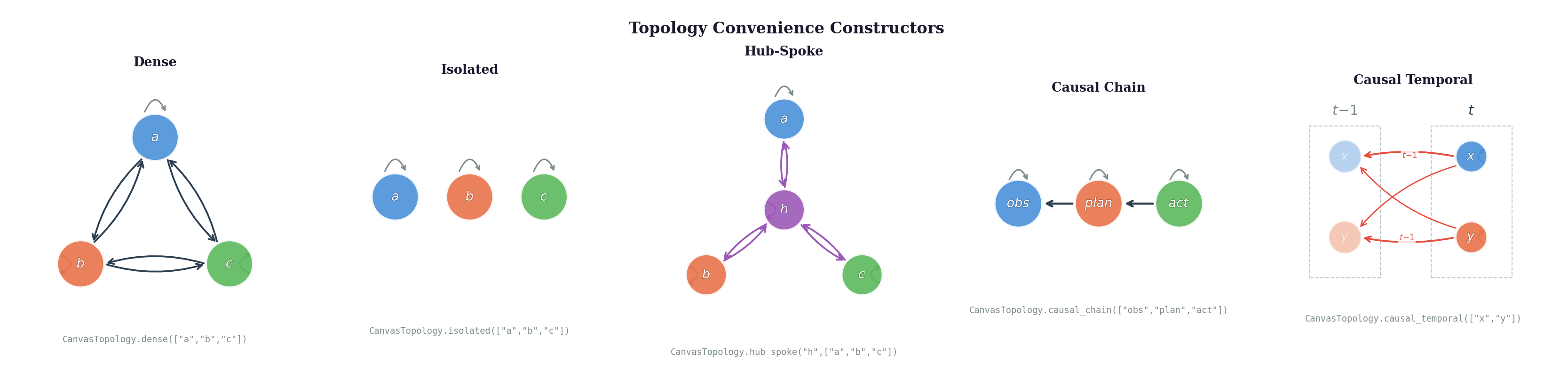
CanvasTopology.dense(["a", "b", "c"])          # fully connected
CanvasTopology.isolated(["a", "b", "c"])       # block-diagonal
CanvasTopology.hub_spoke("hub", ["a", "b"])    # star topology
CanvasTopology.causal_chain(["obs", "plan", "act"])  # A → B → C
CanvasTopology.causal_temporal(["obs", "act"]) # same-frame self + prev-frame cross
Temporal connectivity
t_src |
t_dst |
Behavior |
|---|---|---|
None |
None |
All src ↔ all dst (dense in time) |
0 |
0 |
Same-frame only |
0 |
-1 |
Src at current frame queries dst at previous frame |
None |
0 |
All src timesteps query dst at each reference frame |
Temporal fill modes
When regions update at different frequencies (e.g., fast at period=1, slow at period=4), a fast region may query a slow region at a timestep where the slow region has no value. The temporal_fill parameter on Connection controls what happens:
| Mode | Behavior | Use case |
|---|---|---|
TemporalFill.DROP |
No connection | Event signals — alerts, anomaly flags, one-shot observations |
TemporalFill.HOLD |
Use most recent past value (default) | State signals — sensor readings, positions, embeddings |
TemporalFill.INTERPOLATE |
Weighted blend of surrounding values | Smooth signals with known update schedule |
from canvas_engineering import Connection, TemporalFill

# State signal: hold the most recent GDP until the next quarterly release
Connection(src="daily_market", dst="quarterly_gdp", t_src=0, t_dst=0,
           temporal_fill=TemporalFill.HOLD)

# Event signal: an alert fires once, don't hold it forever
Connection(src="monitor", dst="alerts", t_src=0, t_dst=0,
           temporal_fill=TemporalFill.DROP)

# Smooth signal: interpolate temperature between hourly readings
Connection(src="fast_control", dst="temperature", t_src=0, t_dst=0,
           temporal_fill=TemporalFill.INTERPOLATE)
Fill resolution operates in real-time space: a slow region with period=4 and 2 canvas frames maps to real times {0, 4}. A fast region at real time 2 sees the natural gap and can interpolate. For period=1 regions, real time equals canvas time — fully backward compatible.
Interpolation order
TemporalFill.INTERPOLATE supports higher-order interpolation via interpolation_order on Connection:
| Order | Method | Anchors used | Best for |
|---|---|---|---|
| 1 (default) | Linear lerp | 2 (nearest past + future) | General purpose |
| 2 | Inverse-distance weighting, 1/d² | 3 nearest | Smooth signals with curvature |
| 3 | IDW, 1/d³ | 4 nearest | Very smooth signals |
Weights are always non-negative and normalized. No learned parameters.
Connection(src="fast", dst="slow", t_src=0, t_dst=0,
           temporal_fill=TemporalFill.INTERPOLATE,
           interpolation_order=2)  # quadratic IDW
Attention mask compilation
mask = topology.to_attention_mask(layout)  # (N, N) float tensor
ops = topology.attention_ops(layout)       # [(src, dst, weight, fn), ...]
The mask is compiled by iterating over connections, resolving temporal constraints and fill modes in real-time space, and setting mask[i, j] = weight for each (query_position, key_position) pair. Fill weights may be fractional for INTERPOLATE connections.
Operators
Connection.operator declares the semantic intent of an edge, separate from the backend attention function (fn). When compile_program() has family information for both endpoints, it auto-sets the operator from the DEFAULT_WIRING table:
| (src family, dst family) | Operator |
|---|---|
| (observation, state) | observe |
| (state, observation) | predict |
| (state, state) | integrate |
| (state, memory) | write |
| (memory, state) | retrieve |
| (state, action) | act |
| (action, state) | intervene |
| (state, residual) | emit_residual |
| (observation, residual) | emit_residual |
| (observation, observation) | attend |
Connections without family information, or family pairs not in the table, keep the default "attend" operator. The operator is metadata for the program layer -- it does not change which attention function runs. fn controls the backend; operator controls the semantics.