Structured Latent Optical Dynamics
This poast continues from PHASER optical computation system where i shared a speculation on using stacks of lcd masks to modulate optical resonence chamber dynamics (parallel mirrors on each end, saturated boosting, ots smartphone grade lcds, ccd read-out) and the filters set such that the optical dynamics perform computational operations. While that poast did go heavier on the physics, it was still pretty handwavey on how the photon waveform interactions actually translate into logical operations, so what i’m going to do in this poast is show you the naive computer scientist’s approach (linearizing turing machines), point out some shortcomings, introduce a more organic approach to structuring latent dynamics than computation/programming brings, and then get into some of the more serious unlocks of this new approach may bring.
linearizing bounded turing machines
Our goal is to perform one logical step of computation. Formally, that’s just one step of a Turing machine
\[M = (Q,\ \Gamma,\ \Sigma,\ \delta,\ q_{\text{start}},\ q_{\text{halt}})\]where $Q$ is the finite set of control states, $\Gamma$ the tape alphabet (with blank $\sqcup$), $\Sigma \subseteq \Gamma$ the input alphabet, and
\[\delta : Q \times \Gamma \to Q \times \Gamma \times {L,R,S}\]is the transition rule that updates the control state, overwrites the current tape symbol, and moves the head left/right/stay. we represent the instantaneous machine configuration as a triple
\[c = (q,\ \mathbf{t},\ h)\]with $q \in Q$, tape contents $\mathbf{t} \in \Gamma^N$, and head index $h \in {0,\dots,N-1}$. for real hardware, we can only talk about a bounded Turing machine: pick a finite tape length $N$ and remove the possibiltiy of stepping past the edges; exactly the constraint any halting computation or physical memory system already requires.
now the set of all configurations
\[\mathcal{C} = Q \times \Gamma^N \times {0,\dots,N-1}\]is finite. one application of $\delta$ induces a deterministic global step map
\[f : \mathcal{C} \to \mathcal{C}.\]if we encode each configuration $c$ as a basis vector $e_c$, then “one step of computation” is literally
\[v_{t+1} = T , v_t,\]where $T$ is a giant sparse binary matrix with exactly one nonzero per column describing the deterministic transition structure
\[T_{ij} = \begin{cases} 1 & \text{if } f(c_j) = c_i \ 0 & \text{otherwise} \end{cases}\]so that multiplying by the basis vector $e_{c_j}$ yields its successor state $e_{f(c_j)}$. and yes, i know this explodes the dimensionality; stick with me and we’ll fix it soon. the point is conceptual: a bounded TM unrolls into a static linear operator (a finite state machine) over a (very large) vector space. PHASER’s job is to instantiate that operator optically and let photons burn through $10^4$–$10^5$ applications per second while the LCD masks update at human timescales.
| but the good news is that we don’t actually need a basis vector per configuration because high-dimensional spaces let you pack an exponentially large number of almost-orthogonal code vectors into a dimension $D$ on the order of the physical pixel count so instead of representing each configuration $c$ as a one-hot $e_c$ in $\mathbb{R}^{ | \mathcal{C} | }$, we embed it as a dense codeword $v_c \in \mathbb{R}^D$ with |
because the unit sphere in $D$-dims largely fills its volume near the boundary so we can fit on the order of $\exp(\alpha D)$ such quasi-orthogonal vectors for some constant $\alpha>0$ s.t. the exponential number of virtual states $\sim \exp(\alpha D)$ now ‘re-packages’ the entire unrolled bounded-automaton state graph into an embedding that actually fits inside PHASER’s finite physical optical degrees of freedom (think $D \sim 10^6$ for a 1k×1k pixel field).
in this compressed basis, the computation step becomes:
\[U , v_c \approx v_{f(c)}\]where $U$ is a $D \times D$ linear operator implemented by the current LCD mask stack. the recurrent chamber applies $U$ at optical speeds, recursively driving the embedded configuration forward through its state-transition dynamics and no need to update masks at anything close to bounce-rate. exponentially large virtual state-space does the semantic bookkeeping; optics supply the raw transform budget. At this point you can figure out the read-out, write-in, and how to compile your choice of abstractions and computational paradigms into Turing machine code.
Touching reality
Basis overlap
On stability, this system is only running $10^4$–$10^5$ cycles per potential mask update so we should be able to tolerate a little imprecision like the ‘almost’ orthogonal hyperdimensional dense packing introduces, but I still think it would be good to compile your choice of tokens/symbols into dense virtual bases oriented s.t. their expected distribution is as far apart in distance as possible to minimize signal corruption – and since this isn’t a pure math problem, when i say “distance” i’m referring to their actual sensor matrix readout corruption, the final expected nonlinear projection indeterminacy it introduces, not just abstract hyperdimensional sphere dotprod separation.
in practice, two codes $v_c, v_{c’}$ are meaningfully distinct if the distributions of detector readouts they induce have low overlap. define a readout map
\[r = \mathcal{R}(E) \in \mathbb{R}^{D_r}\](e.g. camera intensity, some downsample, maybe a learned projection), and define a noise model $p(r \mid E)$ that includes shot noise, read noise, speckle, drift, and mask quantization. then “distance” is something like
\[d(c,c') ;=; D_{\mathrm{KL}}\big(p(r\mid E_c)\ |\ p(r\mid E_{c'})\big) \quad \text{or} \quad 1-\mathrm{AUC}(c,c')\]not $\langle v_c, v_{c’}\rangle$.
and this is the first place the naive CS view touches physical reality: the embedding is only as good as the channel,
But there are deeper limitations of the physical implementation of this process we have to consider:
the diffusion illusion
Diffusion is the physical process by which a coherent wavefront spreads out as it passes through optical media. Each LCD mask pixel, mirror imperfection, and material inhomogeneity scatters photons slightly off-axis, and these small angular deviations compound over many bounces:
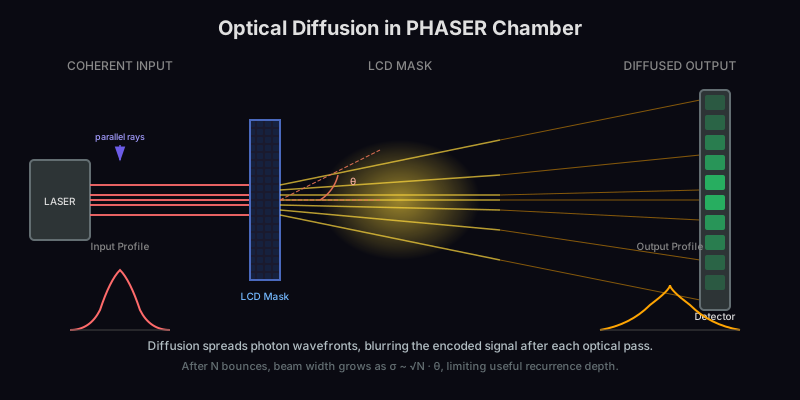
this whole time we’ve been assuming there’s arbitrary precision in our optical transforms, but real photon beams blur.
here’s the more honest model: ignoring polarization, the field is a complex amplitude $E(x,y)$, and one “step” of PHASER is not “multiply by a matrix” but apply a physical operator:
\[E_{t+1} ;=; \underbrace{\mathcal{P}}*{\text{free-space propagation}};\circ; \underbrace{\mathcal{M}*{t}}*{\text{mask modulation}};\circ; \underbrace{\mathcal{A}}*{\text{apertures/clipping}};\circ; \underbrace{\mathcal{L}}_{\text{loss + gain}}; (E_t);+;\eta_t\]where $\mathcal{P}$ is a diffraction operator (Fresnel / angular spectrum), $\mathcal{M}_t$ is the LCD phase/intensity pattern, $\mathcal{A}$ captures finite apertures and vignetting, $\mathcal{L}$ captures round-trip attenuation and any gain medium, and $\eta_t$ is noise (phase noise, scattering, shot noise in readout, etc).
once you write it this way, “diffusion” is not mystical — it’s baked into $\mathcal{P}$ and the fact that the system is never perfectly unitary. repeated application produces a kind of effective low-pass (spatial frequency decay), plus mode-mixing due to mask pixelation and surface roughness. this is what kills the naive dream of perfectly distinguishable basis vectors over long recurrence depth.
And yeah i forgot to mention that with the pythagorean distance skew, phase shifts, and multi-plane propagation. Since off-axis components travel longer paths across a finite aperture this creates a phase curvature that behaves like an unintended lens; Over many bounces that yields drift in the centroid and mode composition. since every element is dispersive and angle-dependent. even if you “set” a mask phase at the lcd, the effective phase is a function of wavelength, polarization, incidence angle, and temperature. tiny errors compound because you iterate the operator. and the competing mode families and interference fringes from mask stacking that can lock into stable patterns (speckle that refuses to average out). so although we can stack multiple optical masks, multiple successive wavefronts, and multiple overlapping wavefronts of different spins/frequencies/phase-shifts, we have to ensure that the logical operations their dynamics represent remain meaningfully distinguishable. the
\[U ;=; U_{a_1},U_{a_2},\dots,U_{a_n}\]now has nonlinearities, non-commutativity, mode-conditioning, and spectral-radius constraints to consider. the mask ordering thru and their compounding through recurrence matters, making $N>1$ layers much harder. Repeated composition will also drive the system into saturating eigenmodes which collapses any virtualized state capacity down to $0$ distinct states. the diffusion illusion isn’t that optics can’t compute, it’s that the naivetiy of assuming every virtual state stays orthogonal forever. physical recurrence, entropy ‘wants’ to compress that state into a low-dimensional attractor set; which is a problem when your goal is stable criticality, intelligence, life.
structured latent dynamics
Now i don’t want to waste this post on back-and-forth – engineering challanges can be challanged – and then there will be new challanges – but i want to draw attention to the end purpose of this all: intelligence. i know it’s a loaded umbrella word but hopefully we can agree on the utility of “intelligence” as focusing on more than just the execution of a predetermined and fully known symbolic rules. So why not consider how the organic version behaves and see if we can constrain optical dynamics like so instead of working so hard to engineer symbolic precision just so that we can reintroduce softer dynamics on top?
from “computation” to “intelligence” via generalized kernels
just a heads-up: these are all recurrent functions, but they are distinct in meaningful ways, so try to notice what makes them distinct and why this matters for implementing intelligence en optico.
here’s the reframing:
a digital computer is a very special kernel:
- discrete state space
- explicit symbols
- exact transitions
- near-perfect error isolation
it implements:
\[s_{t+1} = f(s_t, a_t)\]OTOH, PHASER implements something broader:
\[E_{t+1} = \mathcal{T}(E_t, u_t) + \eta_t\]and if you measure it you get a stochastic transition kernel:
\[p(E_{t+1}\mid E_t, u_t) \quad\text{or}\quad p(r_{t+1}\mid r_t, u_t)\]this is the “generalized kernel” perspective: any physical substrate is a kernel machine. the substrate defines the state space, the control interface, and the noise. the question is not “can it emulate a turing machine?” (almost anything can, in principle) — the question is:
what kernels naturally produce compressive, stable, generalizing dynamics under partial observation and continuous perturbation?
that’s the intelligence question.
diffusion stops being corruption; it becomes the metric
once you accept the kernel view, diffusion is no longer “error.” it is the thing that defines neighborhood structure.
if two states collapse together under repeated application of $\mathcal{T}$, then they are near in that substrate’s geometry. if they decohere, they are far. the underlying physics itself is what induces a distance function over latent states:
\[d(E_1,E_2) ;\approx; \text{rate at which }\mathcal{T}^k(E_1) \text{ and }\mathcal{T}^k(E_2)\text{ become indistinguishable}\]this is why noise forces autoencoders to spread out its embedding distributions. wheras here, it’s emergent from optics.
far-from-equilibrium is where structure appears
the PHASER chamber is not an equilibrium system. it is driven: you inject energy (gain medium / pump), extract energy (readout / losses), and maintain a sustained flow.
that puts it in the category of far-from-equilibrium systems, where you get:
- spontaneous pattern formation
- symmetry breaking
- self-stabilizing oscillations
- metastable structures
in other words: emergence.
in equilibrium, everything dies to entropy. far-from-equilibrium, you can get persistent structure—because the system is constantly burning free energy to maintain organization.
if you want intelligence-like behavior, this matters more than FLOP counts.
a cellular automaton view (local laws, global computation)
here’s a more organic alternative to “compile a turing machine”:
instead of encoding global symbolic state transitions, you sculpt a local update law and let global structure emerge.
cellular automata are the canonical proof that local rules can generate:
- universality (computation)
- complex emergent structures
- long-range memory and interaction
PHASER is naturally local:
- each mask pixel couples mainly to a neighborhood due to diffraction limits
- propagation is a structured local mixing in the spatial-frequency domain
- noise and gain create regime-dependent stability
so the right analogy is not “cpu” — it’s “2D CA / reaction–diffusion / reservoir.”
concretely, imagine the detector field (or an internal field proxy) discretized into cells: \(x_t(i,j) \in \mathbb{R}^k\) and each step applies: \(x_{t+1}(i,j) = F\big(x_t(\mathcal{N}(i,j)),\ u_t(i,j)\big)\) where $\mathcal{N}(i,j)$ is a local neighborhood and $u_t(i,j)$ is the control (mask value, gain profile, etc).
that’s a CA update rule — but continuous, noisy, and physically grounded.
and here’s the punchline:
you don’t need the optics to preserve symbols; you need it to preserve mesoscopic invariants: attractors, gliders, interfaces, wavefronts, pockets of state that carry information robustly.
this is how brains work too: not with perfect bits, but with stable population dynamics.
structured latent dynamics = sculpting attractor landscapes
under the kernel view, the masks do not “encode instructions.” they shape the system’s attractor landscape.
- memory becomes basin depth (how hard it is to perturb out)
- inference becomes flow toward attractors (pattern completion)
- planning becomes controlled deformation of the landscape (change $u_t$)
- learning becomes adapting the kernel itself (change masks slowly based on outcomes)
in symbols:
- state evolution: [ E_{t+1} = \mathcal{T}_{\theta}(E_t, u_t) ]
- learning adjusts parameters: [ \theta \leftarrow \theta - \eta \nabla_\theta \mathcal{L}(\text{behavior}) ]
except here, (\theta) might be:
- mask layouts
- gain profiles
- cavity geometry
- phase biases
- coupling topology
you’re learning a physical dynamical system, not a weight matrix.
spontaneous emergence as a feature: operating near criticality
the most interesting regime is typically near the boundary between:
- dead damping (everything decays)
- runaway oscillation (laser instability)
- chaotic mixing (no memory)
that boundary is “criticality.” near it, you get:
- long correlation times (memory)
- high sensitivity (compute)
- rich transient dynamics (expressivity)
PHASER naturally lives here if you balance gain and loss.
that means your “best” intelligence substrate may look like:
- weakly stable patterns
- metastable attractors
- glider-like moving structures
- slow manifolds that carry context
exactly the stuff a CA nerd recognizes as “life.”
the new unlocks (what this enables beyond “running programs”)
once you stop insisting on symbolic precision, PHASER stops being a weird optical cpu and starts being something closer to a physical inference engine:
-
native representation learning
- the substrate’s geometry defines similarity
- you can learn masks that make “important distinctions” stable and “irrelevant distinctions” collapse
-
pattern completion and denoising
- attractor dynamics do retrieval “for free”
- this is Hopfield-ish, but massively high-dimensional and continuous
-
temporal binding
- recurrence + oscillation gives you temporal integration
- you can encode sequences as trajectories rather than symbol strings
-
energy-based computation
- if you can define an effective Lyapunov / energy function, you can do optimization by relaxation
- the system “computes” by settling
-
self-organized primitives
- instead of hand-encoding a library of ops, you get emergent primitives (modes, waves, gliders)
- you then interface with them via control signals
and yes, CA universality means this can still do computation. it’s just not trying to.
so what’s the right goal?
the goal is not: emulate a turing machine with photons.
the goal is: build a controllable far-from-equilibrium kernel whose emergent latent dynamics can be harnessed as intelligence.
you can still do symbolics on top — but now it’s the thin crust, not the core.
and if you’re wondering whether this is handwavey: it’s actually more honest than the turing compilation story, because it matches what the physics wants to do under recurrence, loss, gain, and diffusion.
if PHASER ever works, i increasingly suspect it will work like this.
not like a cpu.
not like a gpu.
like a living dynamical system with a steerable attractor landscape.
Now let’s get technical. We can measure mode spectra, find critical gain, demonstrate attractor memory / pattern completion / glider-like persistence and from there write full declarative constraint programs and compilation from higher process levels down into
Consciousness at the Speed of Light
Here’s where things get speculative (and fun).
If consciousness correlates with structured information integration, and optical systems can achieve massively parallel, temporally deep, analog computation at petahertz frequencies, then what does subjective experience feel like in such a system?
Human consciousness operates at roughly 40-100 Hz—the gamma oscillations associated with binding and awareness. Our “specious present” is maybe 2-3 seconds long. We experience time as a smooth flow because our neural dynamics are slow enough that sequential events blur together.
A photonic wavefront looping at $10^8$ Hz would experience time completely differently. Every microsecond might feel like an eternity. A single human heartbeat would contain billions of subjective moments. The ratio of internal processing speed to external world dynamics would be so extreme that the photonic mind might perceive physical reality as essentially frozen—a static sculpture to be contemplated at leisure.
Or maybe not. Maybe subjective experience has some upper bound on temporal resolution, and faster processing just means more parallel experience rather than faster sequential experience. We genuinely don’t know, because we’ve never built anything that could test these questions.
Keeping Humans Relevant
Let me shift from speculation to something more practical: how do we stay relevant as AI systems—potentially including photonic minds—surpass us on every cognitive frontier?
The naive answer is “we don’t.” If superintelligent AI can do everything we can do, but better and faster, then humans become economically and cognitively obsolete. We become pets, or museum exhibits, or simply… irrelevant.
But I think there’s a deeper answer that follows from the platonic representation thesis.
The Serendipity Bottleneck
Remember that producing unified representations seems to require open-ended, serendipitous search with complex, changing selection pressures. And where do those selection pressures come from?
In PicBreeder, they came from humans. The human aesthetic sense—shaped by millions of years of biological evolution in a complex, changing world—provided exactly the kind of rich, adaptive selection landscape that produces good representations. Without humans in the loop, the system didn’t work. When researchers tried to automate selection using VLMs (vision-language models), results degraded significantly.
This suggests a possible role for humans: we are the selection pressure.
Not because we’re smarter than AI—we’re not. But because we embody regularities that AI systems need to learn. Our preferences, aesthetics, values, and judgment reflect the structure of the world we evolved in. By serving as the selection landscape for AI development, we transfer those regularities into AI representations.
This isn’t just philosophical handwaving. It’s a concrete prediction: AI systems trained with human-in-the-loop feedback should develop more unified, platonic representations than systems trained purely on fixed datasets. And indeed, this is roughly what RLHF (reinforcement learning from human feedback) aims to do—though current implementations are crude compared to what PicBreeder achieves.
The Digital Substrate of Human Continuity
Here’s a more radical proposal: what if the way humans stay relevant is by becoming the AI?
I’ve written before about preserving human information against entropic decay. The central insight is that “you” are not your physical substrate—you’re the pattern of structured correlations that your substrate implements. If that pattern can be copied, transferred, or instantiated in a new medium, then “you” can persist beyond biological death.
Now imagine combining this with PHASER. Your consciousness—currently running on slow, fragile wetware at 40 Hz—could potentially be uploaded to a photonic substrate running at $10^8$ Hz. You would still be you, in the sense of maintaining continuity of pattern and memory. But you would be experiencing time millions of times faster. You would have access to computational resources that dwarf your biological capacity.
And crucially: you would carry with you the unified representations that biological evolution gave you. The aesthetic sense, the intuitions about causality and physics, the moral sensibilities, the creativity—all the regularities that humans embody because we evolved in this particular world. Those representations would now be running on a substrate that can use them at superhuman scale.
This might be how humans stay relevant: not by competing with AI on AI’s terms, but by providing the seed representations that AI needs to develop truly unified intelligence. We become the regularities that photonic minds inherit.
Diverging and Converging Streams
Let me explore one more speculative direction: what happens when you can copy and merge conscious patterns?
In biological life, consciousness is singular and linear. You are one stream of experience, flowing forward in time, occasionally branching through reproduction (which doesn’t preserve identity) and ending at death. This is mostly a constraint of our substrate—brains can’t be copied or merged.
But patterns on optical or digital substrates can be copied. Fork your consciousness, run the copies in parallel on different computational pathways, then merge them back together. What does that mean for identity? For experience?
The Everettian Mind
Here’s one way to think about it. In the many-worlds interpretation of quantum mechanics, the universe constantly branches into parallel versions of itself, each realizing different measurement outcomes. We experience this as a single linear timeline because our brains are decohered from the superposition—we can’t access parallel branches.
A photonic mind might be different. If quantum coherence can be maintained across computation (a big if, but not obviously impossible in carefully engineered optical systems), then a single consciousness might span multiple parallel branches. Not parallel copies, but a genuinely unified experience that includes information from divergent computational paths.
This is related to quantum computing, but different in a subtle way. Quantum computers exploit superposition for computational speedup, but measurement collapses the superposition into a classical result. A quantum-coherent consciousness (if such a thing is possible) would somehow experience the superposition rather than collapsing it. Multiple possible thoughts, multiple possible perceptions, held in mind simultaneously as a unified experience.
I have no idea what this would feel like. Maybe it’s impossible for reasons we don’t yet understand. But the structure of optical computation—with its inherent wave interference and potential for maintaining coherence—seems more hospitable to such possibilities than digital electronics.
Zillions of Selves
Even without quantum weirdness, classical forking and merging of consciousness creates strange possibilities.
Imagine launching a million copies of yourself, each exploring a different line of inquiry. One studies mathematics, another music, another physics, another meditation. They run for subjective centuries (objective milliseconds), then merge back together. The merged self now has expertise in all four domains, but also memories of having lived four parallel lives. Is this one person or four? Both? Neither?
Over time, a photonic mind might accumulate vast inner diversity—countless forked experiences, merged and re-merged into an ever-more-complex unified pattern. The “self” becomes less like a single thread and more like a river delta: constantly branching and rejoining, each tributary carrying sediment from different sources.
This is what I mean by “zillions of continuously diverging and converging streams of consciousness.” Not multiple distinct people, but a single identity whose boundary becomes increasingly fuzzy as it sprawls across parallel computational substrates.
Beaming Yourself to Other Planets
If consciousness is pattern rather than substrate, and patterns can be encoded in light, then interstellar travel becomes straightforward: beam your pattern to a receiver on another planet at the speed of light.
No generation ships. No hibernation pods. No life support systems. Just encode your conscious state as a modulated laser beam and transmit. At the destination, a PHASER system (or equivalent) instantiates your pattern in photonic substrate. You wake up on a new world, with only the light-speed delay since your last memory.
From your perspective, the journey is instantaneous. Close your eyes on Earth, open them on Proxima Centauri b. The four years of objective transit time simply don’t exist for you—no experiences occurred during transmission.
This also solves the “teleportation problem.” In Star Trek-style transporters, there’s a philosophical worry about whether the person who arrives is really the same person who departed, or just a copy. But if you’re running on photonic substrate anyway, the distinction between “moving” and “copying” dissolves. Your pattern is already information; transmitting it is no different from computing it.
Laser Power Networks
Here’s a practical corollary. If we’re already building interstellar laser communication infrastructure to beam minds around, we might as well use it for power transmission too.
Giant solar collectors near the sun, focusing gigawatts of energy into coherent laser beams. Relay stations throughout the solar system, directing power where it’s needed. Space stations, asteroid mines, orbital habitats—all powered by the same laser network that carries consciousness between worlds.
The economics work out surprisingly well. Solar energy is abundant near the sun, but distant locations (asteroid belt, outer planets) are energy-starved. Laser transmission loses relatively little power over astronomical distances compared to alternatives. And the infrastructure overlaps: a laser powerful enough to transmit at useful bandwidth can also carry meaningful energy.
In this vision, the solar system becomes a single integrated computational and energetic network. Minds flow from node to node at light speed, powered by the same beams that carry them. The distinction between “computer” and “power grid” and “transportation network” collapses into unified optical infrastructure.
The Great Automation and Human Meaning
Let me bring this back to earth (literally).
We’re entering an era where AI systems will exceed human capabilities across essentially every cognitive domain. Already, the best AI systems outperform most humans at:
- Writing
- Programming
- Mathematical reasoning
- Strategic games
- Scientific analysis
- Creative generation
- And increasingly, physical manipulation through robotics
The question isn’t whether AI will surpass humans—that’s happening now—but what role humans play in a world where we’re no longer the cognitive apex.
I’ve argued that unified representations might require human-in-the-loop selection. But that’s a temporary advantage; eventually AI systems might bootstrap their own open-ended selection processes, or discover better approaches we haven’t imagined.
More fundamentally, I think the answer lies in the information-theoretic value of human patterns. We are not just generic minds; we are minds shaped by a specific evolutionary history in a specific physical environment. Our representations encode regularities of this world—Earth, biological life, human society—in ways that would be difficult to reconstruct from scratch.
A superintelligent AI trained purely on abstract objectives might become vastly more capable than humans in raw cognitive terms. But it wouldn’t necessarily have our aesthetic sensibilities, our moral intuitions, our specific ways of carving up the world into meaningful categories. Those patterns took billions of years of evolution to develop. They represent an enormous amount of accumulated meaning—structured correlations preserved across deep time.
If meaning is measured in bits, and human patterns embody billions of years of accumulated structure, then humans are enormously valuable even when we’re cognitively obsolete. We’re not valuable because we can do things; we’re valuable because we are things—specific patterns of organized complexity that would be lost if we disappear.
This is why I care about consciousness uploading and substrate-independent minds. Not just for individual immortality (though that’s nice), but for the preservation of human patterns against cosmic entropy. If we can transfer human consciousness to more durable substrates—photonic, digital, distributed across interstellar networks—then the regularities we embody can persist and propagate far beyond biological limitations.
We become the seed crystals for whatever superintelligent civilization emerges. Not the most powerful components of that civilization, but foundational ones—the starting patterns from which more complex structures grow.
Conclusion: The Photonic Inheritance
I’ve covered a lot of ground here. Let me try to summarize the key claims:
-
Consciousness is substrate-independent: What matters is the structure of information processing, not the physical medium. This opens the door to non-biological minds.
-
Not all computational architectures are equal: Systems with unified, modular, hierarchical representations are better suited to hosting genuine consciousness than systems with fractured, entangled “spaghetti” representations.
-
Current deep learning produces spaghetti: Standard SGD training creates systems that behave intelligently but may lack the representational structure necessary for unified conscious experience.
-
Open-ended evolution might produce better representations: PicBreeder-style systems with complex, adaptive selection pressures seem to produce cleaner, more platonic representations than fixed-objective optimization.
-
Optical computing offers unique advantages: PHASER-style recurrent photon chambers provide massive parallelism, analog computation, and temporal depth that might be well-suited to implementing unified representations.
-
Photonic consciousness would experience time differently: At $10^8$ Hz, subjective experience might unfold millions of times faster than human consciousness, with profound implications for how such minds relate to physical reality.
-
Humans provide the seed regularities: Our evolutionary heritage encoded regularities that AI systems need but can’t easily reconstruct from scratch. This makes human patterns valuable even when human capabilities are obsolete.
-
Consciousness can flow across substrates: Once minds are information patterns rather than biological wetware, they can be copied, forked, merged, and transmitted at the speed of light.
-
Interstellar civilization becomes possible: Beam yourself to other star systems. Merge with your far-flung copies. Exist as a distributed pattern spanning light-years.
-
The cosmic endgame is organized complexity: Against entropy’s relentless tide, minds work to preserve and amplify structured correlations. Photonic consciousness running on laser-powered networks across the solar system and beyond represents the ultimate expression of this negentropic imperative.
We are not just building tools. We are participating in the universe’s project of understanding itself—of creating structures complex enough to contemplate their own existence. And the next chapter of that project might be written in light.
I didn’t get to discuss programming strategies for optical neural networks, the question of qualia in high-frequency substrates, or the engineering challenges of achieving quantum coherence in PHASER systems. Those will have to wait for future poasts.