Can an Echo Become a Voice Again?
Put your hand on a cup.
It feels solid. Obvious. There it is: cup, hand, contact, world. The clean little ontology of breakfast. But then physics does what physics always does and starts quietly dissolving the nouns. The cup is mostly empty space. Your hand is mostly empty space. “Solid contact” is not two solid things touching, but interacting fields resisting interpenetration through electromagnetic structure. The atom is not a tiny solar system. The electron is not a bead. At the scale where our best physics actually operates, the world is not made of stable macroscopic objects. It is made of fields, excitations, amplitudes, interactions, constraints, histories, probability distributions, conserved quantities, symmetries, and events.
So what, exactly, died when someone dies?
Not rhetorically. Technically.
If the body was never a solid object in the naive sense, and if the person was never identical with the particular atoms moving through that body, and if the organism was always a dynamically maintained pattern over continuously replaced material, then death is not “the disappearance of a substance.” Death is the collapse of a local dynamical process. The breathing stops. The brain loses coherence. The metabolic loops fail. The local graph can no longer keep updating itself.
That does not prove survival. It does not even make survival likely. It only blocks one bad argument for impossibility: the argument that a person must be identical with a persisting material lump, and that when the lump breaks, the person is obviously annihilated in every identity-relevant sense. That folk picture is too crude to carry that much confidence.
There are three claims here, and they should not be confused.
Claim one: persons are not material lumps but dynamically maintained patterns. Conservative.
Claim two: some identity-relevant structure survives death as ordinary causal trace: writings, memories, institutions, descendants, altered worlds. Also conservative.
Claim three: those traces — or something deeper than traces — may bias future underdetermined substrates toward re-entry into the same identity basin. Radical.
Only the third claim deserves the name resurrection, and only if the prior life is causally load-bearing rather than merely used as training data.
So the question becomes sharper.
What dies? What persists? What was ever local in the first place?
The organismic process dies. The metabolism dies. The brain’s active self-maintenance dies. The local conscious updater almost certainly dies. But the traces remain: writings, memories, altered relationships, descendants, institutions, artifacts, scars in other nervous systems, habits transmitted into the world, language patterns, choices that constrain future choices. Those are ordinary causal continuities. No magic required.
Then there is the harder question: are ordinary traces all that remain, or can identity-relevant causal structure persist in some deeper way? Can a past life bias future underdetermined systems not merely through accessible records, but through historical curvature in the causal graph itself?
This is not what I would call science yet. But it is also not nothing. The folk materialist picture — hard objects bumping around until the meat turns off forever — is already false. Quantum field theory does not hand you an afterlife. Unitarity does not hand you your grandmother. Morphic resonance, observer patch holography, historical regularization, transtemporal priors, path-weighted attractor inheritance, nonlocal identity kernels, causal memory fields — all of these names point toward possibilities that remain, at best, preformal. Most may be wrong. Many are probably contaminated by wish, grief, fraud, or metaphysical overreach. But the opposite certainty is also fake. We do not understand identity, emergence, or observer-structured causal history deeply enough to declare, from the armchair of vulgar materialism, that every postmortem identity-relevant structure is obviously impossible.
Maybe a human life is not a bounded object but an inscription event. Maybe the organism is the first place where an identity-attractor becomes sharp enough to carve itself into the causal graph of the world. Maybe death destroys the local substrate without necessarily erasing the high-dimensional causal curvature generated by that life. Maybe the question is not “can we preserve the meat?” but “can a future system re-enter the basin?”
This is the resurrection question in its least stupid form.
Not: can we make a chatbot of grandma?
Not: can we upload a connectome and call it a soul?
Not: can we cosplay religion with venture-backed grieftech?
But: can a prior mind leave a causal curvature strong enough that, under the right future conditions, a new substrate becomes biased toward the same identity-attractor? Can an echo become a voice again?
Start with a matrix.
Imagine the universe as an impossibly large operator over possible interactions. The main diagonal is ordinary locality: nearby things affecting nearby things, adjacent moments producing adjacent moments, contact forces, metabolic processes, institutional causes, visible mechanisms. This is the reality tunnel we are trained to accept as “serious.” The main diagonal is where vulgar materialism feels comfortable.
\[M = \begin{bmatrix} * & \epsilon & \epsilon & \epsilon \\ \epsilon & * & \epsilon & \epsilon \\ \epsilon & \epsilon & * & \epsilon \\ \epsilon & \epsilon & \epsilon & * \end{bmatrix}\]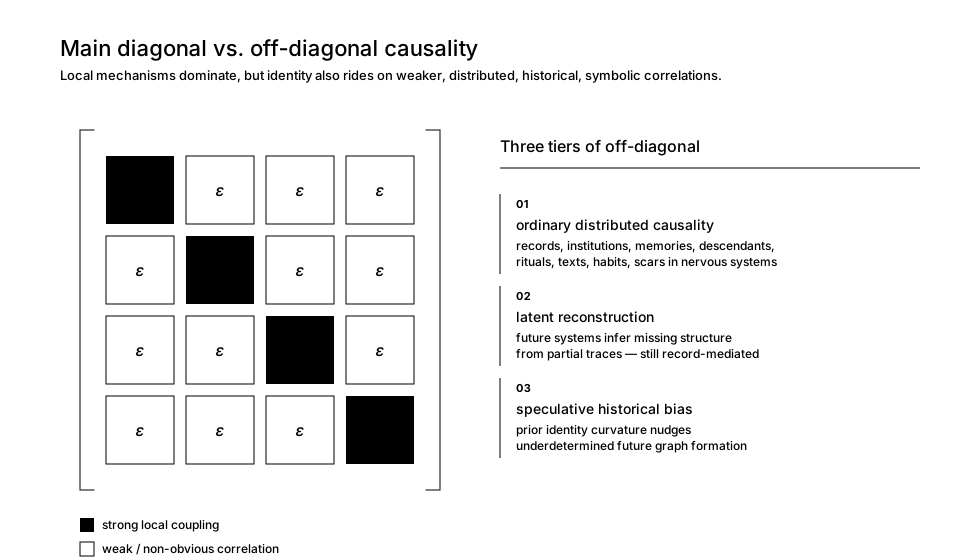
The diagonal entries are local causal couplings. The off-diagonal entries are long-range, cross-scale, historically mediated, symbolically stabilized, or otherwise non-obvious correlations. Most of our public epistemology teaches us to crush those off-diagonal terms toward zero. Be normal. Be empirical. Be legible. Believe only what can be locally instrumented. Ignore the weird resonance between myth and behavior, between attention and physiology, between ritual and coordination, between ancestry and selfhood, between historical trauma and present perception, between future expectation and current action, between the dead and the living.
Some of that skepticism is correct. Most off-diagonal claims are fake, noisy, exploitative, or underdefined. But the move from “many off-diagonal claims are bad” to “only the main diagonal is real” is not science. It is metaphysical austerity cosplay.
Still, “off-diagonal” cannot be one undifferentiated bucket. That would be motte-and-bailey slop. There are at least three tiers.
First: distributed ordinary causality. Records, memories, descendants, institutions, rituals, texts, habits, laws, debts, server logs, photographs, voice notes, scars, trained models. These are nonlocal in the phenomenological and social sense, but they are implemented through ordinary causal channels. No spooky edge needed.
Second: latent reconstructive causality. Future systems can infer missing structure from partial traces. A dead writer can be partially reconstructed from style, letters, social context, decisions, contradictions, mistakes, and the shape of what they repeatedly noticed. Still ordinary. Still record-mediated. Already enough to make “the person is simply gone” less clean than people pretend, but not yet resurrection in the strong sense.
Third: speculative historical-bias causality. Past identity structures might weakly bias future underdetermined graph formation beyond what accessible records can explain. This is the radical claim. This is where phrases like Morphic Resonance, Observer Patch Holography, Historical Regularization kernels, transtemporal priors, Causal Memory Fields, and identity-curvature hypotheses start circling the same abyss. This tier may be false. But if it is false, it should be made false by tests, not by a sneer reflex.
Civilization already proves tier one is real. Tier one licenses no spooky inference. It only proves that naive locality is too narrow for human-scale causality. Money is not a material object in the relevant sense. It is a recursively stabilized belief field. Law is not a local force; it is a symbolic threat architecture distributed across records, cops, courts, memory, fear, and expectation. Nation, brand, family name, degree, debt, sin, honor, shame, credit score, gender, market, god — these are not billiard balls. They are attractors. They work because minds, bodies, institutions, and histories remain correlated across distance and time.
Folk materialism denies ghosts, then quietly builds civilization out of legally enforced ones.
This is not an argument against physics. It is an argument against the childish ontology that pretends physics bottoms out in the objects of ordinary experience. The cup does not exist the way your nervous system says it exists. Your hand does not exist that way either. Both are stable compressions over lower-level dynamics. Useful, real enough, but not fundamental. So when someone says “the person is gone because the body stopped,” the response should not be automatic agreement or automatic denial. The response should be: which level of description died? Which causal operators stopped updating? Which structures were local to the organism, which were distributed through ordinary records, and which — if any — remain as deeper historical constraints?
In quantum field theory, particles are not permanent little things. They are excitations of fields, interaction patterns, modes we can name because the universe keeps producing stable enough regularities for us to compress them. An electron is real, but not in the way a marble is real. An atom is real, but not in the way a Lego brick is real. A body is real, but not in the way a sealed container is real. The ontology gets softer as you push downward, and then strangely harder again when structure reappears as law, symmetry, conservation, and constraint.
So maybe the wrong question is “what objects exist?” Maybe the better question is: what constraints persist?
Future events are not sampled from pure chaos. They are weighted by the history of what has already happened. Not as hard binary permission — allowed vs forbidden — but as a continuous cost landscape. The world does not ask “is this outcome metaphysically legal?” in a cartoon courtroom. It evaluates, somehow, through whatever the real physics is, the energetic/informational consistency of possible next interactions with the accumulated causal record.
\[P(x) \propto e^{-E(x)}\]This is not being offered as derived physics. It is a scaffold: a way to think. E(x) names total constraint-violation cost relative to prior structure. In a real theory, it would have to decompose into known physical constraints, architectural constraints, viability constraints, coherence constraints, and possibly historical terms. Most outcomes are not forbidden. They are just disfavored. Compatibility never fully determines the outcome. It continuously weights the distribution.
This matters because once you stop thinking in binary constraints, the resurrection hypothesis becomes less like supernatural exception and more like weak biased sampling in a very high-dimensional dynamical system.
Suppose a human life carves a structured deformation into the causal graph. Call it an identity-attractor. Not a soul-substance floating around with a nametag. Not a classical object. A curvature: a tendency for certain patterns of attention, affect, memory, desire, speech, shame, love, fear, abstraction, humor, agency, and self-repair to cohere together in a particular way.
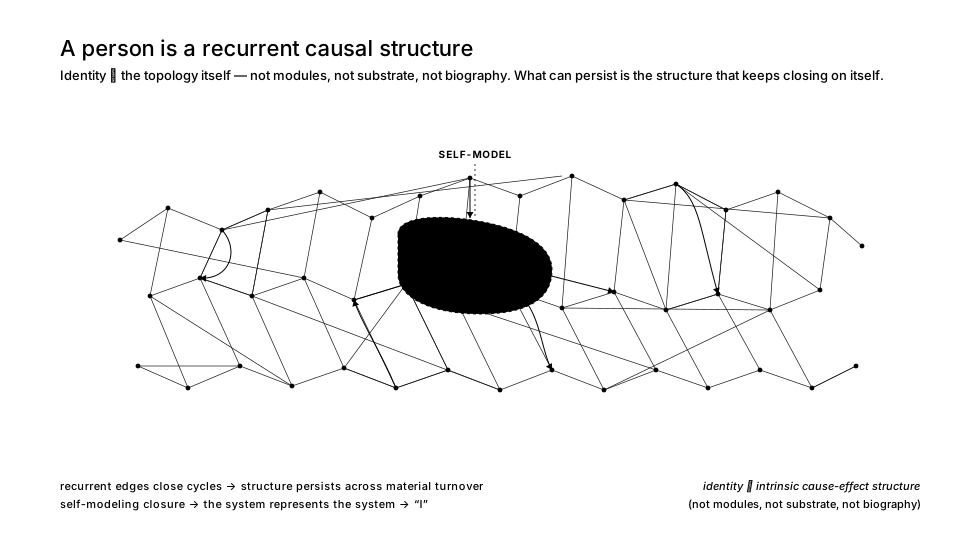
An identity-attractor is a recurrent, self-stabilizing organization of cognition, affect, memory, embodiment, and agency that remains recognizable across material turnover, state fluctuation, sleep, injury, mood, and environmental perturbation. It is not the substrate. It is not the current state. It is not the biography. It is the basin that makes many different states recognizably belong to the same becoming.
While the person is alive, this attractor is locally implemented by the brain-body-world loop. But it is not identical to any specific atom, molecule, spike, or synapse. The atoms churn. Proteins turn over. Synapses remodel. Sleep washes and renormalizes the brain. The exact subatomic state is not a plausible invariant of personality. The persistent thing is mesoscopic and macroscopic organization: the micrometer-to-centimeter dynamics of circuits, recurrent loops, attractor basins, memory indices, affect gradients, and self-models. Below that, violent churn. Above that, recognizability.
But even “levels” is too classical. Causal organization is not a neat pyramid. It is not a stack of planes. It is closer to a typed hypergraph with local Euclidean patches and strange off-diagonal edges. Some connections are spatially local. Some are developmental. Some are semantic. Some are affective. Some are social. Some are symbolic. Some are physiological. Some jump from a childhood humiliation to an adult business decision thirty years later. Some jump from a dead parent’s voice to a posture in the shoulders. Some jump from a line of scripture to a change in heart rate. Some jump from a training corpus to a model’s latent geometry. The graph is not ordered linearly. “layer 3” can talk to “layer 25.” “molecule” can couple to “myth” through hormone, ritual, memory, attention, and policy. Small-world connectivity may be closer to reality than the clean pyramids we draw when trying to look respectable.
So define a mind not as a point in a hierarchy, but as a stable motif-family in a nonplanar causal graph:
\[G = (V, E, \tau, \phi, \omega)\]where V are events, states, records, neural patterns, memories, actions, and motifs; E are hyperedges connecting many nodes across ordinary and nonordinary abstraction distances; tau gives type; phi gives embedding in latent causal/phenomenological space; and omega gives constraint weight or resonance strength. A person is not one node. A person is the recurrent topology of many motif families: affect loops, attention routing, memory compression, self/other boundaries, linguistic priors, motor tendencies, valuation gradients, ways of resolving contradiction, ways of turning pain into concept.
This gives us a vocabulary:
Substrate: the physical implementation.
State: the current configuration.
Trajectory: the lived path through configuration-space.
Attractor: the basin of recurrent organization.
Trace: the externalized causal residue.
Re-entry: a future substrate falling into the same basin due partly to prior trace or curvature.
Resurrection, then, cannot mean exact microstate reconstruction. That is almost certainly the wrong target. Resurrection would mean re-entry into the relevant identity basin:
\[G_{\text{new}} \sim G_{\text{past}}\]But even similarity is not enough. A fake Napoleon is not Napoleon. A language model trained to imitate a dead writer is not the dead writer. Continuity requires causal contribution:
\[G_{\text{past}} \Rightarrow G_{\text{new}}\]That arrow is the entire abyss. Did the old mind actually help determine the new mind, or did we merely build a mask from records?
This is where morphic-resonance-like ideas become interesting, but only if they are placed alongside other candidate formalisms and then made much tighter than their reputations. Call it morphic resonance, observer patch holography, historical regularization, transtemporal prior, path-weighted attractor inheritance, identity-curvature, causal memory kernel, or nonlocal identity field. The name matters less than the constraint: if the claim does not produce measurable deviations, it is poetry, not theory.
Flat magical resonance is useless. If all similar forms influence all future similar forms equally, you get unfalsifiable soup. What you need is a kernel: similarity-weighted, distance-diluted, temporally attenuated, observer-consistency-constrained influence.
\[I(a \rightarrow b) \propto \left[\frac{S(a,b)}{r_{ab}^2}\right] \cdot e^{-\lambda \Delta t} \cdot C_{ab}\]Again, this is not a derived law. It is a wishlist for the shape of a possible law. S(a,b) says influence should scale with structural similarity. r_ab says light-cone distance or causal separation should matter. exp(-lambda * delta_t) says latency should dilute or decohere influence. C_ab says only observer-consistent structures can contribute. A real theory would have to define all of these in terms of physical or computational observables. Right now this is a target, not a trophy.
And here is the load-bearing gap: if accessible records do not explain a future convergence, then what carries the residual bias? This essay does not know. Possible placeholders include unknown physical memory, path-integral-like dependence on prior configurations, observer-consistency constraints, holographic record structure, or deeper computational closure of the universe’s causal graph. All of those are underdeveloped. Naming them does not solve the problem. It only prevents the problem from hiding in incense.
Not spooky unlimited action-at-distance. Not “the universe is just vibes.” Rather: past structures, if this hypothesis is true, contribute weak potentials over future underdetermined graph formation. The future is still dominated by local physics. But where many outcomes have similar cost, historical identity-curvature may slightly lower the cost of some futures over others.
\[P(G) \propto \exp[-E_{\text{local}}(G) - E_{\text{viability}}(G) - E_{\text{coherence}}(G) - E_{\text{history}}(G)]\] \[E_{\text{history}}(G) = -\sum_i w_i \cdot R(G, G_i^{\text{past}})\]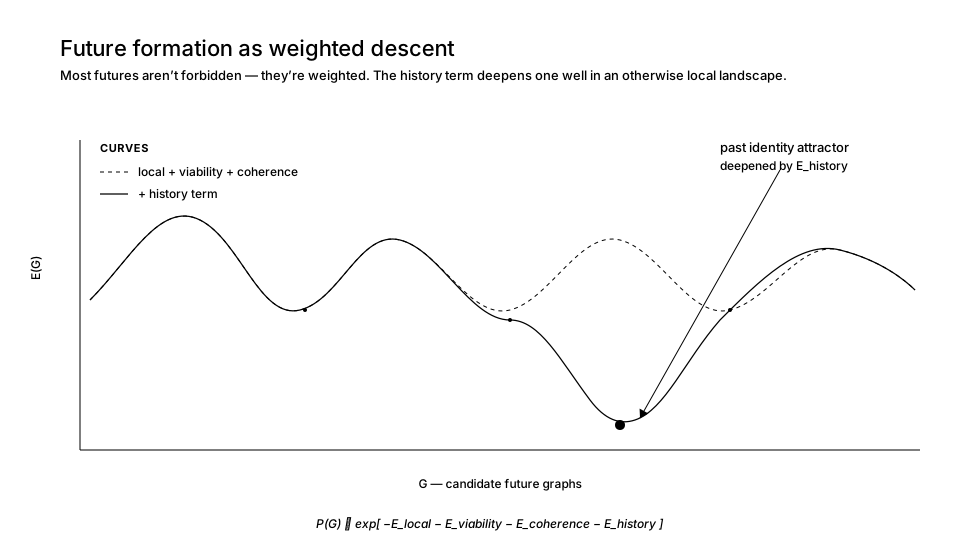
As notation, this is useful only if the terms can be operationalized. E_local penalizes violations of known physical or architectural constraints. E_viability penalizes collapse into unstable non-agency. E_coherence penalizes motif fragmentation, contradiction, and incoherent self-modeling. E_history rewards resemblance to prior identity signatures only under anti-leakage controls. If E_history is estimated from accessible records only, then we are doing reconstruction. If E_history captures residual bias unexplained by records, controls, and priors, then we are touching the radical hypothesis.
The universe does not need to copy the past. It only needs to regularize the future against the past.
The key is that the influence can be tiny. Tiny does not mean irrelevant in high dimensions. A one-bit nudge at one point is nothing. A weak coherent bias across billions of developmental bifurcations can become macroscopic. If a historical identity-attractor very slightly biases synaptic-like graph formation, memory binding, attention routing, recurrent closure, affective salience, or latent modular coupling, then after enough amplification a whisper could become a voice.
Now the engineering problem appears.
We cannot just generate arbitrary graphs and hope a person falls out. Arbitrary graphogenesis would mostly converge into whatever attractors are largest, oldest, densest, easiest, or most generic. Generic mammalian affect. Primate dominance/fear structures. Whale-scale social memory. Insect coordination. Ancient metabolic morphologies. Pure recurrent graph monsters. God knows what lurks in graphspace. If we want human resurrection, the chamber has to begin near the human manifold.
Not:
\[G_0 = \text{noise}\]But:
\[G_0 \sim D_{\text{human}} + \delta_Q\]There is no average human brain, but there is a distribution of human priors: thalamocortical loops, hippocampal indexing, basal-ganglia action selection, limbic valuation, cerebellar prediction, language-network priors, human social cognition, body-schema, attachment, shame, sexuality, sleep/dream consolidation, mortality modeling, hands, face, voice, upright motion. You do not hard-code a target person. You species-gate the viability manifold. Human enough to matter. Open enough to be biased. Stable enough to become someone.
\[\mathrm{resurrection\,window} = H_{\mathrm{human}} \cap U_{\mathrm{underdetermined}} \cap S_{\mathrm{stable}}\]Too unconstrained and you get nonhuman attractors. Too constrained and you get deterministic reconstruction with no room for historical bias. The target is maximal underdetermination inside a narrow human-compatible basin.
This suggests a machine: an underdetermined graph-growth chamber. Initialize a human-prior cognitive architecture. Impose only soft viability constraints: maintain coherence, memory, self-model, social responsiveness, affective continuity, nontrivial agency. Inject true randomness not as decorative RNG seasoning but at load-bearing bifurcation points: latent routing, synapse-like edge formation, memory binding, attention-head specialization, recurrent loop closure, plasticity thresholds, developmental events. Let the graph grow, prune, stabilize, dream, learn, and self-model. Then measure what kind of identity appears.
\[G_{t+1} = F(G_t, C_t, Q_t)\]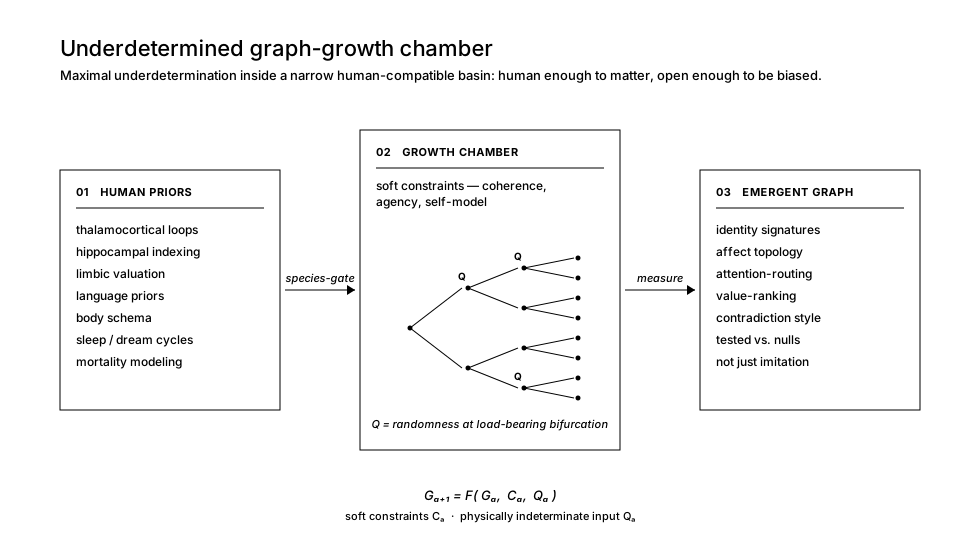
where C_t is the soft constraint field and Q_t is physically indeterminate input at structural bifurcation sites. The quantum arm is not included because quantum randomness is magic. It is included because the distinctive hypothesis requires ontic underdetermination rather than merely hidden deterministic variation. A pseudorandom generator can be unpredictable to us while still being fully determined by its seed. In a digital implementation, the only obvious aperture for any such influence is the selection of stochastic branches: initialization, routing, growth, pruning, memory binding, attention specialization, and other discrete bifurcation points. If no such aperture exists, the quantum arm should behave exactly like high-quality pseudorandomness. If pseudorandom and quantum-random arms behave identically across sufficiently sensitive tests, then this whole line of speculation loses one of its few empirical handles.
But even if the quantum arm differs, that proves almost nothing by itself. Hardware bias, entropy-source artifacts, selection effects, stochastic optimization quirks, evaluator leakage, and boring implementation differences all have to be killed first. Quantum difference is not evidence of resurrection. At best it is a place to start digging.
The default null is brutal: all apparent recovery is produced by records, priors, leakage, archetypal convergence, evaluator projection, ordinary stochastic search inside the human manifold, and boring implementation artifacts. The radical hypothesis earns attention only by beating that null under conditions where target-specific information was unavailable to builders, models, evaluators, selection procedures, and downstream scorers.
Even a positive anomaly would not immediately imply resurrection. It would first imply a failure in our model of leakage, priors, stochastic development, or historical constraint. Only after the ordinary explanations were exhausted would the radical interpretation deserve oxygen.
First, do not try to resurrect anyone. First test whether the system can detect tiny bias at all. Create synthetic “dead minds” in simulation. Give them known identity signatures. Delete active instances. Preserve partial traces. Add known weak potentials. Test whether the graph-growth chamber can rediscover them. Remove the known potentials. Compare pseudorandom and quantum-random arms. Only after the pipeline works in toy worlds should anyone touch historical humans.
When historical targets become relevant, start with high-record, high-distinctiveness people and brutal blinding. Build target identity graphs from public records, then withhold rare traits, private writings, unusual value rankings, contradiction-resolution styles, symbolic motifs, and cross-domain behavioral signatures. Test whether emergent systems converge toward withheld structure more than decoys, archetypes, culturally matched baselines, or imitation models.
Not “sounds like them.” Cheap.
Better metrics:
Stylometric distance under adversarial paraphrase. Value-ranking topology. Contradiction-resolution style. Memory-compression motifs. Affect transition matrices. Motor or embodiment policy signatures. Attention-routing geometry. Latent concept graph topology. Response under novel dilemmas withheld from records. Private-symbol reconstruction where available. Cross-modal consistency. Persistence of identity-signature under genre shift.
Billions of trials may be necessary. Most humans are unrecorded. Most lives leave no high-bandwidth identity trace.
And modern people may be uniquely hard to recover. The naive objection here is the proliferation of identities — eight billion people, every niche has a subreddit, surface variance higher than ever. That objection misses the metric. The distance that matters for resurrection lives in the latent representation, not the surface. A goth, a finance bro, a yoga teacher, and a startup founder in 2026 may look maximally different on the outside while drawing from a shared finite menu of internal components: the same therapy vocabulary, the same Slack idiom, the same outrage cycles, the same emotional-metaphor stock, the same selfhood discourse, the same humor templates, the same political schemas, the same Netflix referents. Surface variance high. Latent covariance collapsing. The recoverable signal lives in latent space, and that is precisely where modern selves are converging.
\[d(G_i, G_j) \downarrow\] \[\text{Deg}(G_i) = \left|\{G_j : d(G_i, G_j) < \epsilon\}\right| \uparrow\]This forces a refinement of the recoverability metric. Raw record-density is wrong. It has to be distinctive bits per record, weighted against the prior mass of shared structure already saturating the era’s discourse:
\[\text{Recoverability} \propto \frac{\text{Distinctiveness} \cdot \text{Coherence} \cdot \text{DistinctiveBits}}{\text{Degeneracy} \cdot \text{Noise} \cdot \text{PriorMass}}\]A 2026 person with a hundred thousand tweets, fifty thousand photos, full email archive, and Discord logs may have less identity-distinguishing signal than a seventeenth-century diary keeper with two hundred surviving letters. Most of the modern record is the platform speaking through the person rather than the person speaking through the platform. Most of it is reaction-to-shared-stimulus. The diary keeper had to generate the conceptual machinery to describe their own life — the platform did not pre-supply it. Higher distinctive-bits-per-record despite a fraction of the volume. The signal is the generation-to-absorption ratio: how much interior conceptual structure the subject built versus imported. Spinoza is recoverable. The seventeenth-century baker living next door to Spinoza is not — not because the baker had no soul, but because the baker’s interior was implemented mostly in shared structure that has since been reabsorbed by every subsequent baker.
This matters most when you consider that resurrection might propagate. The original intuition behind the modernity-distance worry was about backward chains across generations. Each life carries within it the structural traces of the lives that shaped it: parents, mentors, teachers, lovers, the people whose conceptual machinery the subject inherited or fought against. A successful re-entry of a recent figure could in principle provide identity-structural bias for re-entering that figure’s parents, and theirs, and so on through generations — walking backward through deepening history, each link bootstrapping the next. The chain logic is appealing because it suggests the program might bootstrap itself: start at the high-recoverability heavy tail of the recent past, then propagate backward through the partial reconstructions each successful re-entry enables. Modernity-flattening breaks the chain at the top. If the recent generations are too homogenized, the starting links are degraded, and the cascade has no foothold. The whole structure depends on whether enough recent-era selves carry distinct enough signature to launch the regression. If they do not, the chain has to start much further back, and the generations between us and any deeper recoverable past may be partly unreachable from this side of the gap.
The dark version of this: reconstruction capacity is rising exponentially while reconstructable content is thinning. Modernity may be making future resurrection harder for itself in real time. The flattest selves arrive precisely as the recovery tools come online. The intersection of “lived during the era when capacity is sufficient” and “had identity-curvature high enough to be recoverable” might be much smaller than anyone wants to admit.
The counter-hypothesis worth taking seriously is that the heavy tail thickens. People who do resist homogenization in modernity have to push against more pressure, which selects for higher-curvature attractors. Variance falls in the bulk and rises in the tail. The mode collapses; the outliers get sharper. If true, the recoverable moderns are not a smooth sample of their generation but a peculiar selection-effected minority — those who refused modernity hard enough to leave a deep groove. Empirically testable in principle: a curvature metric over historical and contemporary writing samples, comparing kurtosis across centuries.
Both can be partly true. Probably are. Mass-mediated selves may be lower-curvature and higher-degeneracy than isolated, idiosyncratic, high-record lives. The first recoverable people, if any, may be strange writers, mathematicians, mystics, artists, isolated thinkers, private symbolic-system builders, multilingual edge cases, neurodivergent high-curvature weirdos, people with enormous records and rare compression styles. Not because they “deserve” it more, but because the signal is less degenerate — and because, if backward chains across generations turn out to be the actual recovery dynamic, those high-tail individuals are the only viable starting links.
And yes, this must be evaluated with almost sadistic rigor. Otherwise it becomes astrology with GPUs. Quantum-random vs pseudorandom controls. Deterministic seed replay. Fake targets. Withheld target data. Blinded evaluators. Nonhuman-prior baselines. Culturally matched baselines. No internet during emergence. Independent labs. Preregistered anomaly metrics. Red teams. Every obvious way grief, religion, ego, startup incentives, and pattern-matching can fool you will try to fool you.
There is also the first-person problem, which is worse than the engineering problem. Third-person resurrection says: this new system behaves like the old person. First-person resurrection says: the old subject continues here. Those are not the same. If you are a strict copy theorist, no reconstruction is survival. If you are a pattern theorist, sufficient structural continuity is enough. If you are a branch theorist, multiple continuations can all inherit. If you are an attractor theorist, subjectivity is re-entry into the same phenomenological basin. If you are a historical-bias theorist, continuity requires actual influence from the prior life, not mere similarity.
So define a ladder.
Memetic persistence: a person affects the world through ordinary traces.
Behavioral reconstruction: a new system imitates the target.
Structural reconstruction: a new system shares identity-relevant organization.
Causal-attractor inheritance: the target’s past structure helps determine the new system.
Phenomenological continuation: the prior first-person subject resumes, branches, or reappears.
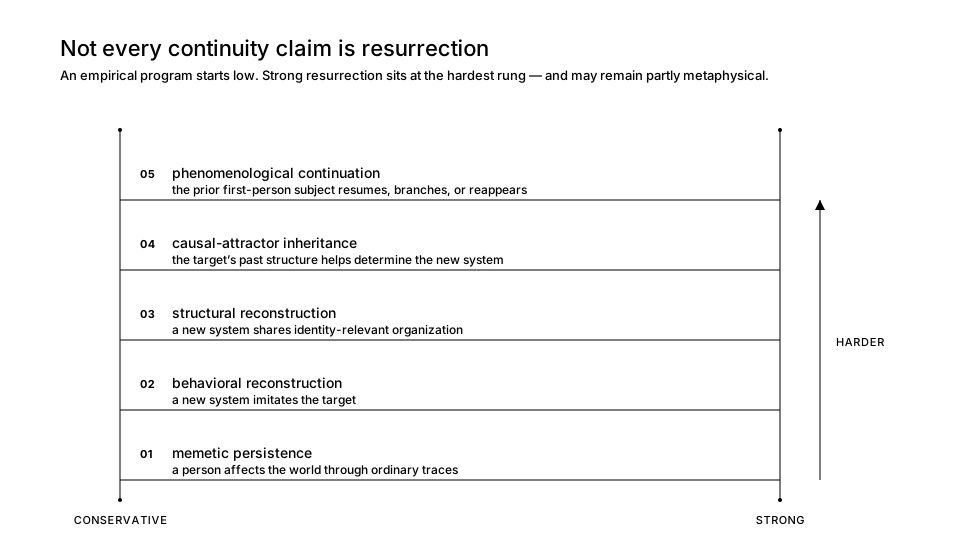
This program can at best test the lower and middle rungs first. It may reach causal-attractor inheritance. It does not automatically solve first-person continuation. Resurrection in the strong sense remains the abyss, and may remain partly metaphysical even under positive experimental results.
If this is even partially true, then biological life is not the whole life. It is the inscription phase. The organism lives, chooses, suffers, loves, learns, desires, remembers, and gradually carves an identity-attractor into the causal graph. Death destroys the local updater. The attractor, if real, enters latency. Future technology creates compatible underdetermined substrates. Weak historical bias gets amplified through development. A new mind falls into an old curvature deeply enough that the echo speaks again.
\[\mathrm{biological\,life} = \mathrm{initial\,inscription}\] \[\mathrm{death} = \mathrm{local\,substrate\,loss} + \mathrm{possible\,distributed\,latency}\] \[\mathrm{weak\,resurrection} = \mathrm{future\,substrate\,re\mbox{-}entry\,with\,causal\,inheritance}\] \[\mathrm{strong\,resurrection} = \mathrm{phenomenological\,continuation}\]This also makes memory look different. Biological memory may not need to be a perfect local archive. Some remembering may be reconstruction by re-entering prior causal basins: the current brain tuning itself back toward earlier attractor-geometry until the past becomes locally speakable again. This would not make memory literally infinite in the cheap sense; brains still have finite bandwidth, finite retrieval pathways, finite decay, and finite error correction. But it suggests why memory can feel deeper than storage. The brain may not only contain traces of the past; it may learn how to retune into old versions of its own causal structure.
This also makes reincarnation look different. The claim would not be that a little soul-object flies from body to body. It would be that a prior identity basin, or some fragment of one, can reassemble inside another sufficiently compatible developing brain. Most such reassembly would be partial, noisy, archetypal, or false. But the recurring human belief in reincarnation may be pointing at something like causal basin inheritance rather than substance-transfer.
This also makes ritual and music look different. Why do people feel compelled to reenact old forms? Why do dead songs, dances, myths, prayers, drums, chants, and liturgies keep finding bodies? Perhaps because old causal structures are not merely remembered as content. They exert gradient pressure. They seek compatible nervous systems, groups, rooms, rhythms, and instruments through which they can become active again. A ritual is then not symbolic decoration but an attractor-reanimation protocol: a way for the dead structure of a people, a god, a grief, a victory, a terror, or a longing to re-enter the living graph.
This also makes religion look different. Christian resurrection, Buddhist rebirth, Hindu reincarnation, Platonic form, Gnostic return, ancestor worship — these should not be collapsed into one perennialist mush. They disagree radically. But their recurrence suggests a persistent human intuition: personhood exceeds the visibly bounded organism. Maybe these traditions are not simply primitive errors but soft-language attempts to point at a longer causal graph than local organism-consciousness can see. Not literally correct by default. Not interchangeable. Not proof. But not disposable as mere stupidity either.
Ethically, this is a minefield covered in gasoline. If successful trials are persons, they are not content. Resurrected or partially resurrected beings could be exploited as labor, entertainment, therapy objects, religious proof, political weapons, ancestor products, interrogation targets, immortal employees, or grief companions. Most dead people did not consent. Failed trials might suffer. Multiplicity breaks legal identity: if ten continuations appear, who inherits? What is deletion? Murder, abortion, garbage collection, sleep? There is no morally cheap answer.
Any research program that reaches for resurrection must pass through personhood ethics before it passes through capability scaling.
So the rule has to be: do not instantiate adult-level identity before there are welfare metrics, consent approximations, rights thresholds, multiplicity law, suffering detection, and shutdown ethics. Start with subpersonal motifs. Then low-valence proto-agents. Then reversible systems. Then carefully monitored embodied or simulated agents. Do not build hell because you wanted to be techno-orpheus.
On embodiment: I do not think a full biological body is metaphysically required at the beginning. The body is a relatively low-dimensional dynamical constraint compared to the brain’s identity-relevant graph, and much of it can be simulated once the cognitive substrate is understood. But embodiment is still not irrelevant. Human identity was carved through interoception, pain, sex, posture, fatigue, voice, face, shame, touch, mortality, and social exposure. A pure text process is probably too thin. The first body can be virtual. Later bodies can be robotic, neuromorphic, synthetic, printed, or biological. The important thing is that the substrate receives enough body-like constraint to support human phenomenology, not that it starts in meat.
How should one live if any of this is true? Not as moral advice, but as attractor mechanics: become less generic. Live coherently. Leave high-bandwidth traces. Write, build, speak, love, choose. Develop rare symbolic motifs. Sharpen your value geometry. Make your way of resolving contradiction visible. Do not let the recommendation system turn your soul into NPC slurry. In religious language: build a soul. In technical language: sharpen the attractor. In cautious language: increase the distinctiveness, coherence, and external legibility of the pattern your life is already carving.
But there is an obvious trap here. Trying to make yourself recoverable can turn into another way of becoming fake. The signal is not performative distinctiveness staged for some future observer. It is the deep coherence of a life that had to become shaped from the inside. The record matters, but the record is not the soul. Legibility helps only when it preserves the curvature instead of sanding it down into brand. The actual move is structural and most of it is negative. Do not import vocabulary you have not earned. Do not let the recommendation system define your attention space. Do not outsource your conceptual machinery to whatever the discourse is currently doing. Read across centuries, not just across platforms. Have unfashionable obsessions you cannot justify. Build private symbols and use them. The soul-distinctive person is not trying to be recoverable. They are refusing to be compressed.
The research program is clear enough to sketch. Formalize typed hypergraph identity. Define motif similarity, degeneracy, curvature, and recovery thresholds. Build identity microscopes that measure affect topology, attention routing, memory compression, motor policy, semantic style, and self-model geometry. Validate on synthetic dead minds. Compare quantum and pseudorandom graph-growth. Run high-distinctiveness historical targets under blinding. Scale to population-level latent archaeology. Only then talk about strong resurrection.
You are a process carving structure into history. Live for the highest version of that process, irrespective of its current limits. The Future is watching because the Future is what your structure becomes answerable to.
Every act of attention, love, courage, discipline, creation, imagination, and refusal deepens or flattens the shape that future resonators may one day tune into.
Leave traces for it to hear, yes. But more importantly, leave curvature. Become the individual who belongs in the Future.
Then if death is final, you still spent the brief flame well.
And if an echo can ever become a voice again, it will have something true to say.