General Unified World Model
A typed causal ontology of civilization, built on canvas-engineering structured latent spaces.


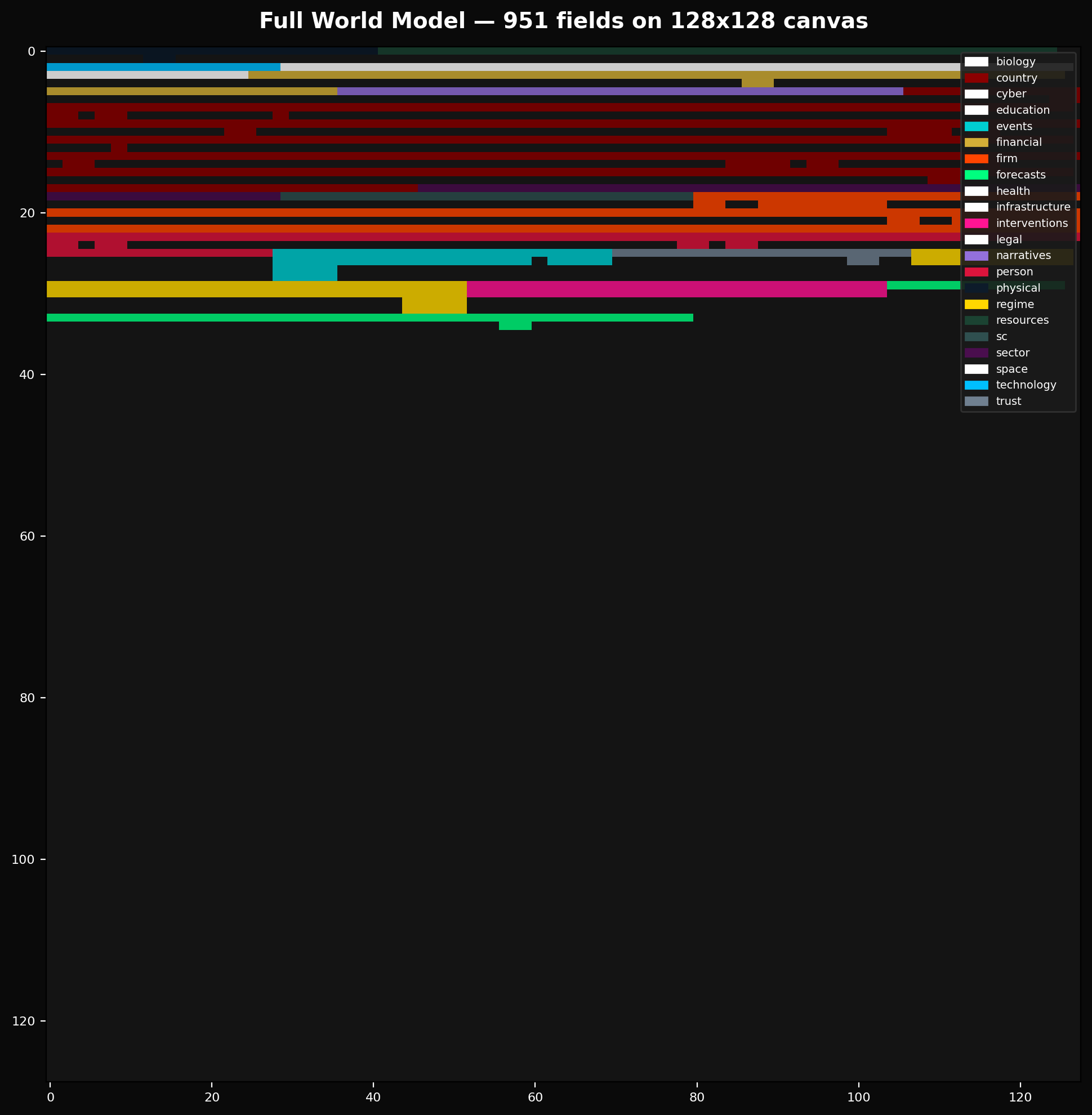
The General Unified World Model (GUWM) encodes 857 fields across 19 semantic layers into a single structured latent space. It learns from heterogeneous, partial data -- no dataset needs to cover every field. The model discovers cross-domain dynamics (how inflation drives bond yields, how policy shapes commodity markets) through shared latent structure and masked training.
Install
With data adapters and CogVideoX backbone:
How it works
graph LR
    subgraph Data Sources
        A[FRED<br/>GDP, CPI, Rates]
        B[Yahoo Finance<br/>Equities, FX, Crypto]
        C[News<br/>Embeddings]
        D[Your Data<br/>Any CSV/API]
    end

    subgraph Canvas
        E["InputSpec/OutputSpec<br/>map columns to fields"]
        F["Canvas (T, H, W)<br/>857 fields on grid"]
    end

    subgraph Training
        G["CogVideoX Backbone<br/>(frozen, pretrained)"]
        H["Loop Embeddings<br/>(trainable, ~0.1%)"]
        I["Masked Loss<br/>only where data exists"]
    end

    A --> E
    B --> E
    C --> E
    D --> E
    E --> F
    F --> G
    G --> H
    H --> I
30-second quickstart
from general_unified_world_model import GeneralUnifiedWorldModel

# Create a world model for the domains you care about
model = GeneralUnifiedWorldModel(
    include=["financial", "country_us.macro", "regime", "forecasts"],
    d_model=64,
)

# Observe known values
model.observe("financial.yield_curves.ten_year", 4.25)
model.observe("country_us.macro.inflation.headline_cpi", 3.1)

# Predict everything else
predictions = model.predict()
print(predictions["forecasts.macro.recession_prob_3m"])
Or use the functional API for more control:
from general_unified_world_model import World, project
from general_unified_world_model.schema.business import Business

# project() accepts a schema root directly
bound = project(
    World(),
    include=["financial", "country_us.macro", "regime"],
    entities={"firm_AAPL": Business(), "firm_NVDA": Business()},
    d_model=64,
)
Visualizations
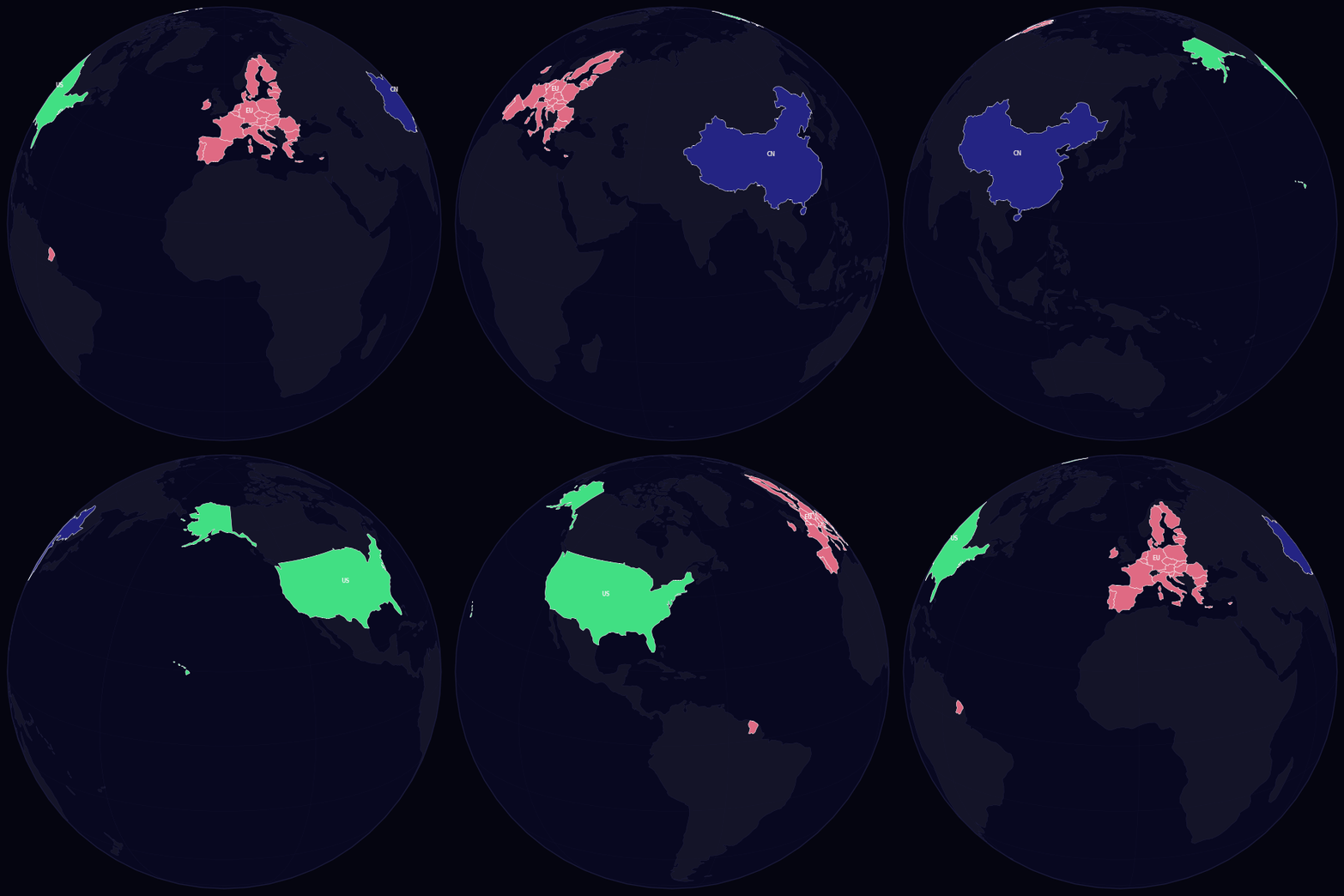
Geopolitical state — rotating globe
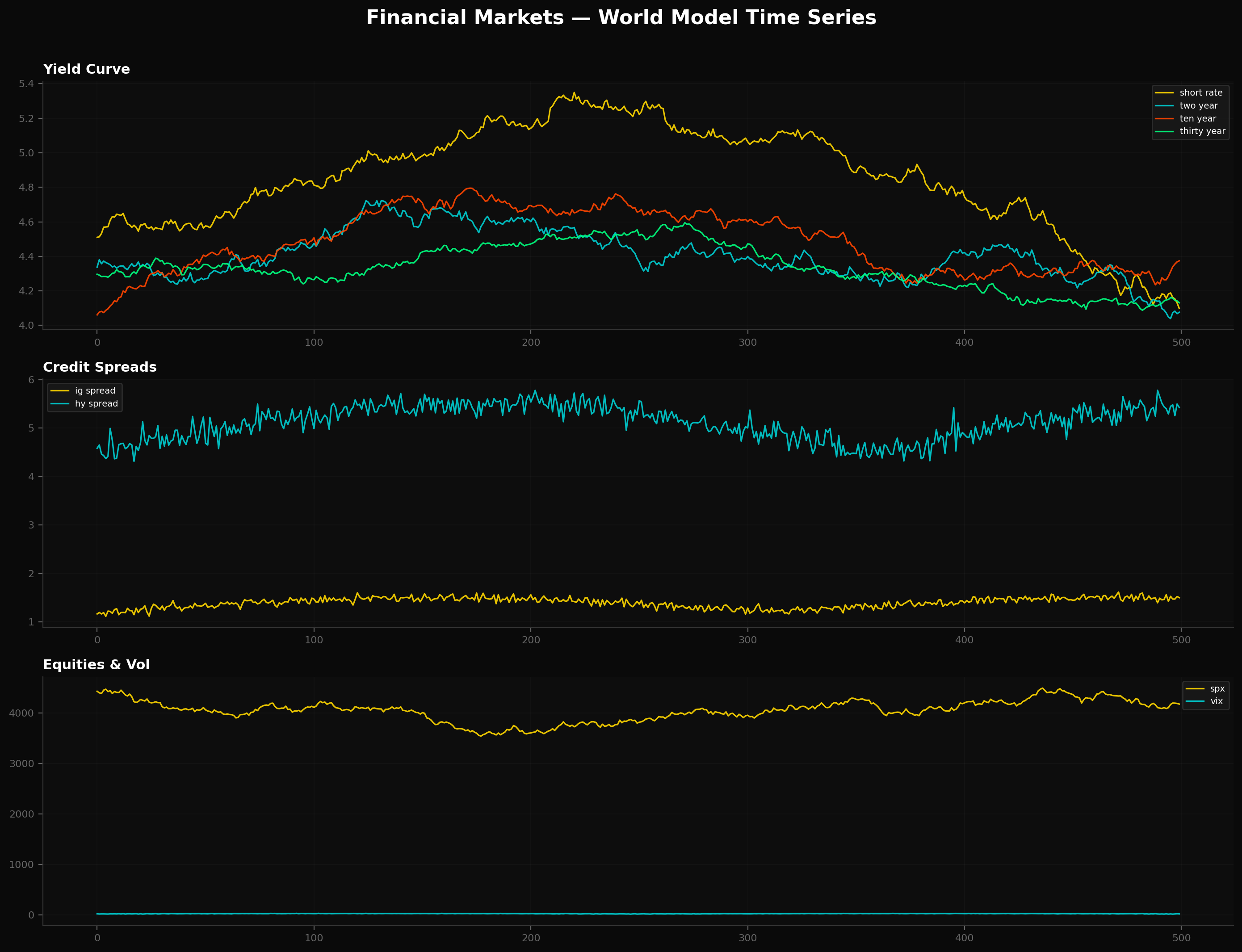
Financial markets dashboard
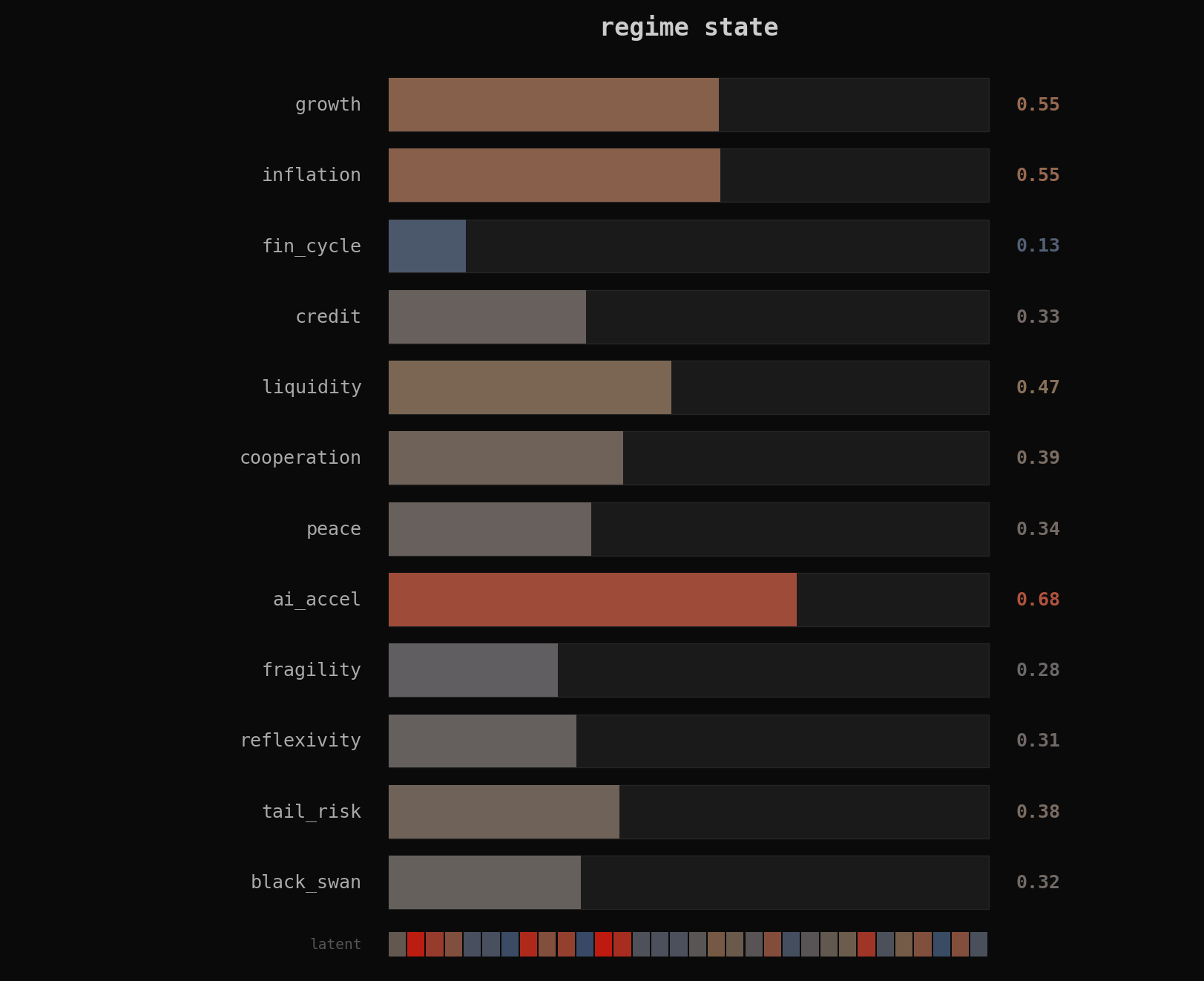
Regime state dashboard
RL environments from world models
Extract Gymnasium environments from trained world models. The same dynamics model yields different agent perspectives — employee navigation, CEO strategy, robot control — each with its own reward landscape.
env = model.to_openenv(
    obs_fields=["firm.financials.revenue", "regime.growth_regime"],
    act_fields=["firm.strategy.capital_allocation"],
    reward_fn=lambda obs, act, info: obs["firm.financials.revenue"].mean(),
)
obs, info = env.reset()
obs, reward, terminated, truncated, info = env.step(env.action_space.sample())
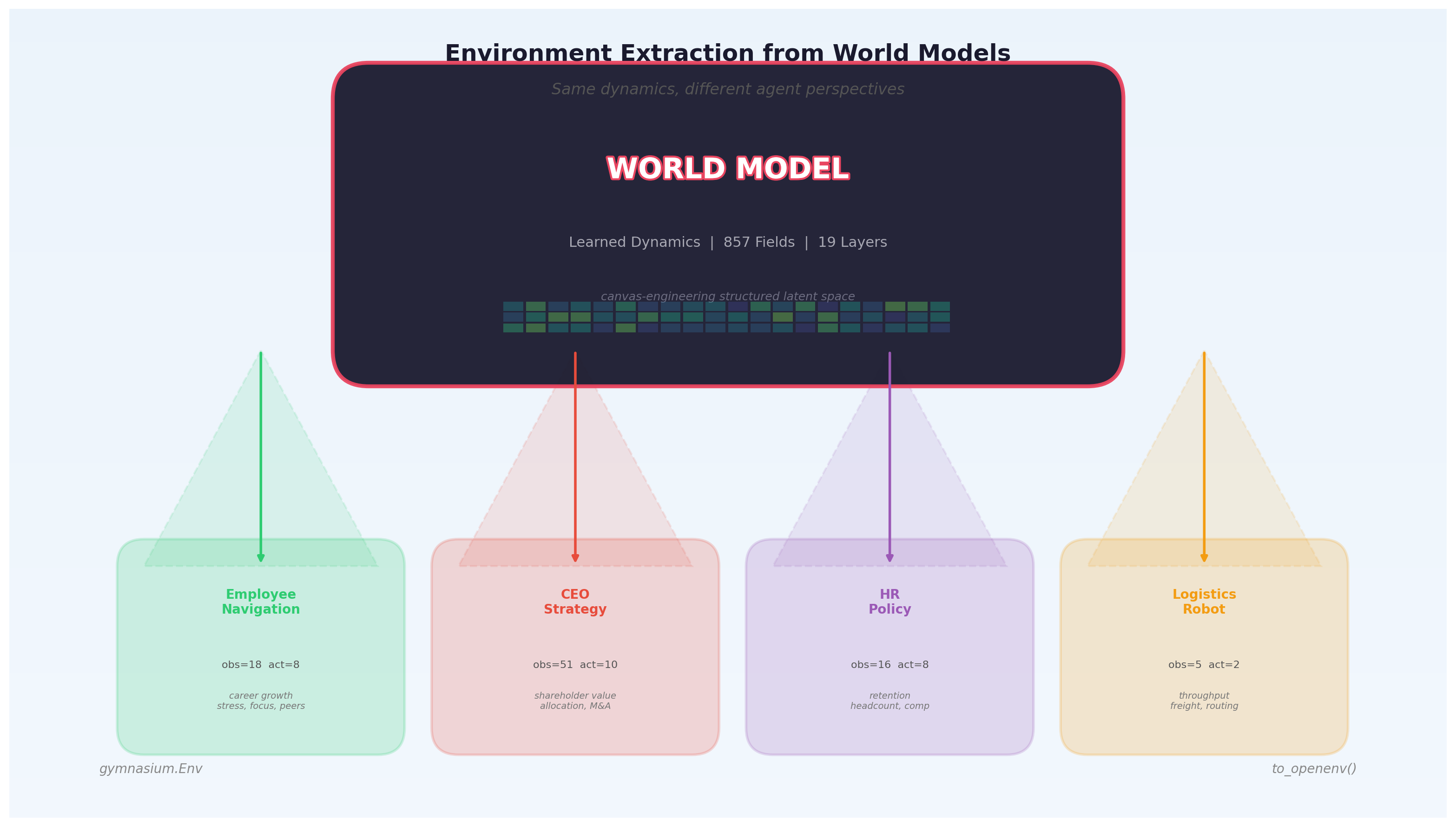
See Environment Extraction for full docs, multi-agent support, and examples.
The 19 layers
| Layer | Fields | Frequency | What it models |
|---|---|---|---|
| Physical | 17 | Annual+ | Climate, disasters, geographic infrastructure |
| Resources | 45 | Hourly--Monthly | Energy, metals, food, water, compute |
| Financial | 68 | Sub-minute--Daily | Yields, credit, FX, equities, crypto, liquidity |
| Macro | 67/country | Weekly--Quarterly | GDP, inflation, labor, fiscal, trade, housing |
| Political | 42/country | Monthly--Multi-year | Executive, legislative, geopolitical, institutions |
| Narratives | 35 | Sub-minute--Monthly | Media, sentiment, elite consensus, positioning |
| Technology | 13 | Quarterly+ | AI, biotech, quantum, robotics, productivity |
| Biology | 16 | Weekly--Annual | Ecosystems, disease, agricultural biology |
| Infrastructure | 27 | Hourly--Annual | Power grids, transport, telecoms, urban systems |
| Cyber | 11 | Daily--Quarterly | Threat landscape, digital ecosystem |
| Space | 9 | Weekly--Annual | Orbital environment, space economy |
| Health | 10 | Weekly--Annual | Healthcare capacity, public health |
| Education | 11 | Monthly--Annual | Education systems, workforce development |
| Demographics | 10/country | Multi-year | Population, dependency, urbanization |
| Legal | 11 | Quarterly--Annual | Regulatory environment, rule of law |
| Sector | 19/sector | Weekly--Quarterly | Per-GICS demand, supply, profitability |
| Supply Chain | 9/node | Daily--Monthly | Bottleneck concentration, fragility |
| Business | 57/firm | Daily--Quarterly | Financials, operations, strategy, risk |
| Individual | 27/person | Daily--Quarterly | Cognition, incentives, network, state |
| Events | 10 | Sub-minute | News, filings, policy, conflict, disaster |
| Trust | 17 | Weekly--Quarterly | Data source reliability, epistemic state |
| Regime | 17 | Weekly--Decadal | Compressed world state, systemic risk |
| Interventions | 13 | Weekly--Quarterly | Policy actions, counterfactual effects |
| Forecasts | 32 | Output | Recession prob, credit stress, conflict |
See the full Schema Reference for mermaid diagrams, field listings, and design rationale for every layer.
Status
Coming soon
The world model is under active development. The schema, projection system, training pipeline, and CogVideoX backbone are implemented and tested. Large-scale training on real data is in progress on H100 GPUs. Trained checkpoints and inference API are coming soon.
What works today: Schema compilation, projection, data adapters, heterogeneous training with masked loss, DAG curriculum, CogVideoX grafting, LLM-driven curriculum design, per-connection attention dispatch (17 attention types), dynamic layout/topology changes.
Coming soon: Pretrained checkpoint release, real-time data ingestion, hosted API.