Architecture
Schema overview
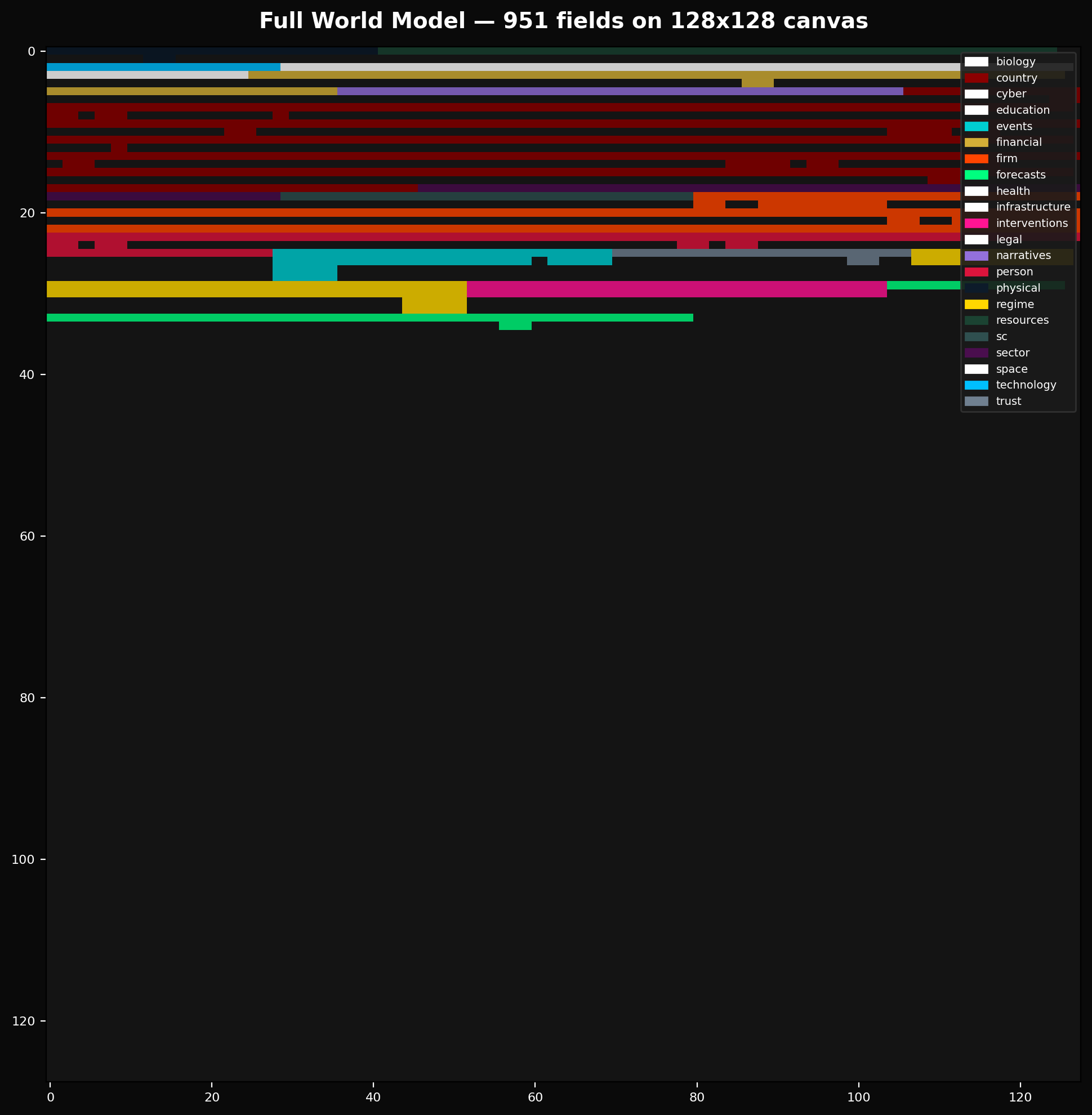
The world model schema is a nested dataclass hierarchy with 19 layers and 857 fields. Each field is a canvas_engineering.Field with declared temporal frequency, loss weight, and semantic type. Fields are arranged on a (T, H, W) canvas grid where the topology defines which positions attend to each other.
graph TD
    subgraph "Planetary (slow, structural)"
        P[Physical<br/>climate, disasters]
        R[Resources<br/>energy, metals, food]
        T[Technology<br/>AI, biotech, quantum]
        BIO[Biology<br/>ecosystems, disease]
    end

    subgraph "Infrastructure"
        INF[Infrastructure<br/>power, transport, telecom]
        CY[Cyber<br/>threats, digital ecosystem]
        SP[Space<br/>orbital, space economy]
    end

    subgraph "Human Systems"
        H[Health<br/>capacity, public health]
        ED[Education<br/>enrollment, workforce]
        DEM[Demographics<br/>population, migration]
    end

    subgraph "Governance"
        POL[Political<br/>executive, legislative, judicial]
        LEG[Legal<br/>regulatory, rule of law]
        INT[Interventions<br/>monetary, fiscal, regulatory]
    end

    subgraph "Markets & Economy"
        F[Financial<br/>yields, credit, FX, equities]
        MAC[Macro<br/>GDP, inflation, labor]
        SEC[Sector<br/>per-GICS dynamics]
        SC[Supply Chain<br/>bottleneck nodes]
    end

    subgraph "Actors & Beliefs"
        BUS[Business<br/>firm financials, strategy]
        IND[Individual<br/>decision-maker psychology]
        NAR[Narratives<br/>media, sentiment, positioning]
    end

    subgraph "Meta & Output"
        EV[Events<br/>news, filings, policy]
        TR[Trust<br/>data source reliability]
        REG[Regime<br/>compressed world state]
        FOR[Forecasts<br/>recession, credit stress]
    end

    P --> R
    R --> F
    MAC --> F
    POL --> INT
    INT --> MAC
    NAR --> F
    BUS --> SEC
    SEC --> MAC
    REG --> FOR

    style REG fill:#ff6,stroke:#333,stroke-width:3px
    style FOR fill:#6f6,stroke:#333,stroke-width:3px
See the full Schema Reference for mermaid diagrams and design rationale for every layer.
Temporal frequency classes
Eight frequency classes span sub-minute to multi-year. Each field's period determines how often it updates on the canvas:
| Class | Period (ticks) | Real-world cadence | Example fields |
|---|---|---|---|
| tau0 | 1 | Sub-minute | market prices, breaking news |
| tau1 | 4 | Hourly | grid load, intraday commodities |
| tau2 | 16 | Daily | commodity closes, port congestion |
| tau3 | 48 | Weekly | jobless claims, inventories |
| tau4 | 192 | Monthly | CPI, PMI, housing starts |
| tau5 | 576 | Quarterly | GDP, earnings, capex |
| tau6 | 2304 | Annual | demographics, infrastructure |
| tau7 | 4608 | Multi-year | regime changes, tech diffusion |
Fields held constant within their period -- a monthly CPI field only updates every 192 ticks, even if the canvas runs at tick-level resolution.
Dynamic entities
Firms, individuals, countries, sectors, and supply chain nodes are created at runtime using dataclasses.make_dataclass. This allows projections to include arbitrary named entities without hardcoding them in the schema:
from general_unified_world_model.schema.business import Business
from general_unified_world_model.schema.individual import Individual
from general_unified_world_model.schema.country import Country
from general_unified_world_model.schema.sector import Sector

bound = project(
    include=["financial", "country_us.macro"],
    entities={
        "firm_AAPL": Business(),       # creates firm_AAPL (57 fields)
        "firm_NVDA": Business(),       # creates firm_NVDA (57 fields)
        "person_ceo_cook": Individual(),
        "country_jp": Country(),
        "sector_semiconductors": Sector(),
    },
    d_model=64,
)
Each dynamic entity is a full dataclass instance (e.g., Business has 57 fields for financials, operations, strategy, market position, and risk). Entity names are arbitrary keys in the entities dict.
Projection system
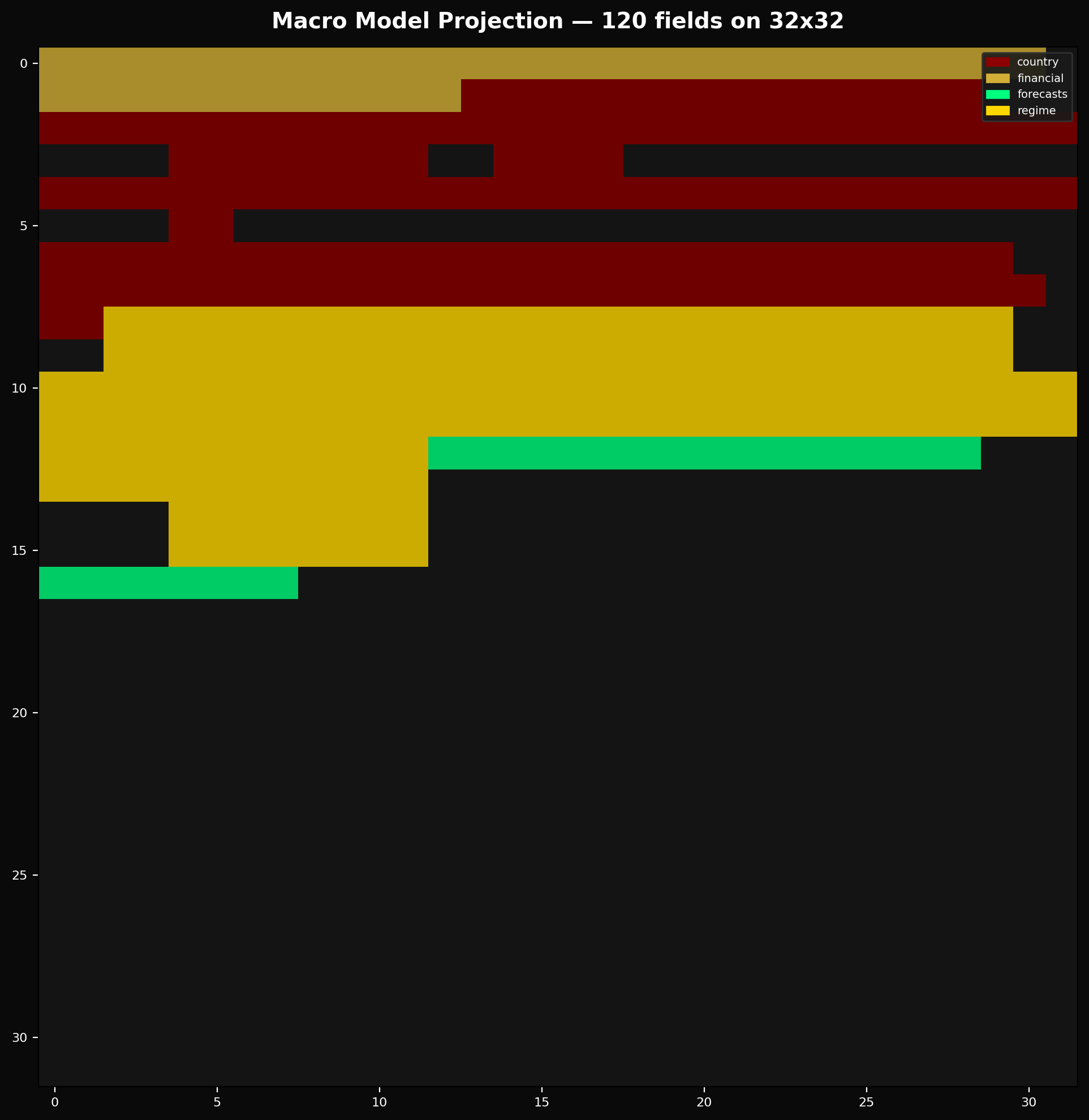
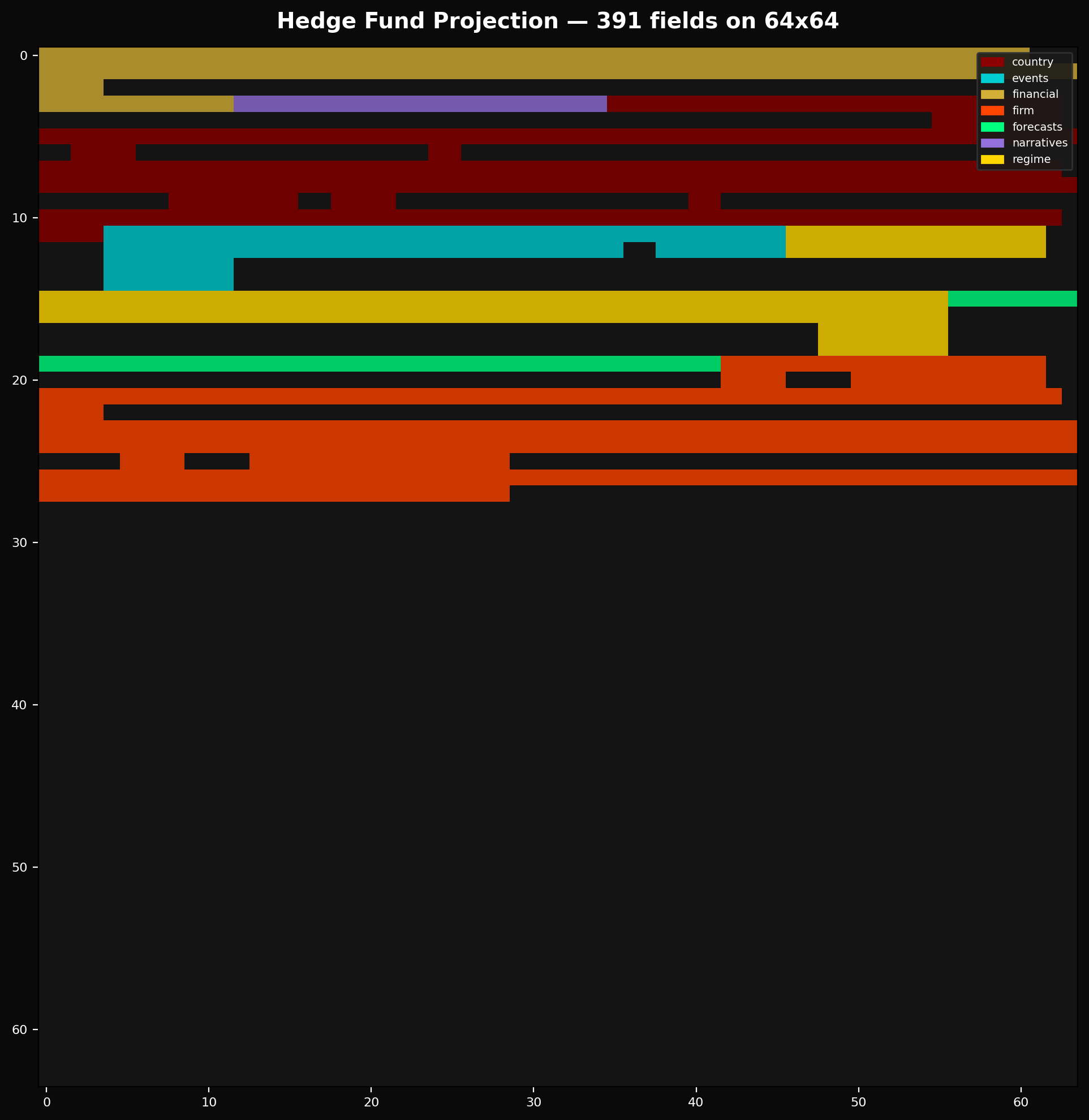
project() declares which parts of the schema to include and compiles them to a BoundSchema with canvas layout and topology:
graph LR
    A["World()
857 fields"] --> B["project()
include/exclude/entities"]
    B --> C["ProjectedWorld
subset of fields"]
    C --> D["compile_schema()
canvas-engineering"]
    D --> E["BoundSchema
layout + topology + mask"]- Start with full
World()instance (857 fields) project()walks the dataclass tree, keeping only fields matchingincludepaths- Dynamic entity instances are added for requested firms/individuals/etc.
- A
ProjectedWorlddataclass is built containing only the active subtree compile_schema(projected_world, T, H, W, d_model)allocates fields on the canvas grid
The result is a BoundSchema with:
field_names-- flat list of dotted field paths on the canvaslayout--CanvasLayoutwith grid positions for each fieldtopology--CanvasTopologywith attention connectionsbuild_semantic_conditioner()-- produces conditioning from field descriptions
Auto-sizing
When H=None, W=None, compile_schema auto-computes the canvas size from the number of fields:
Topology
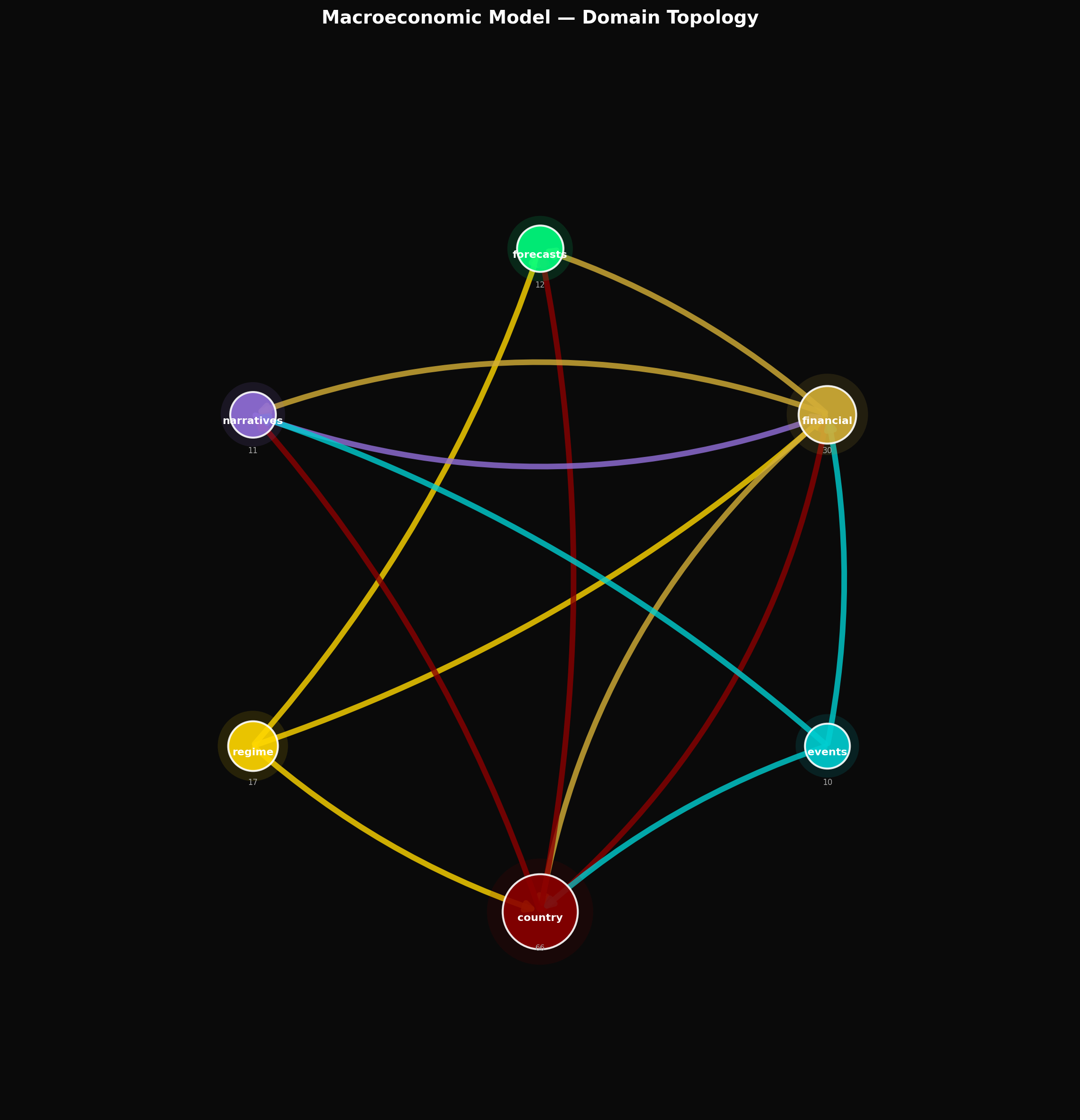
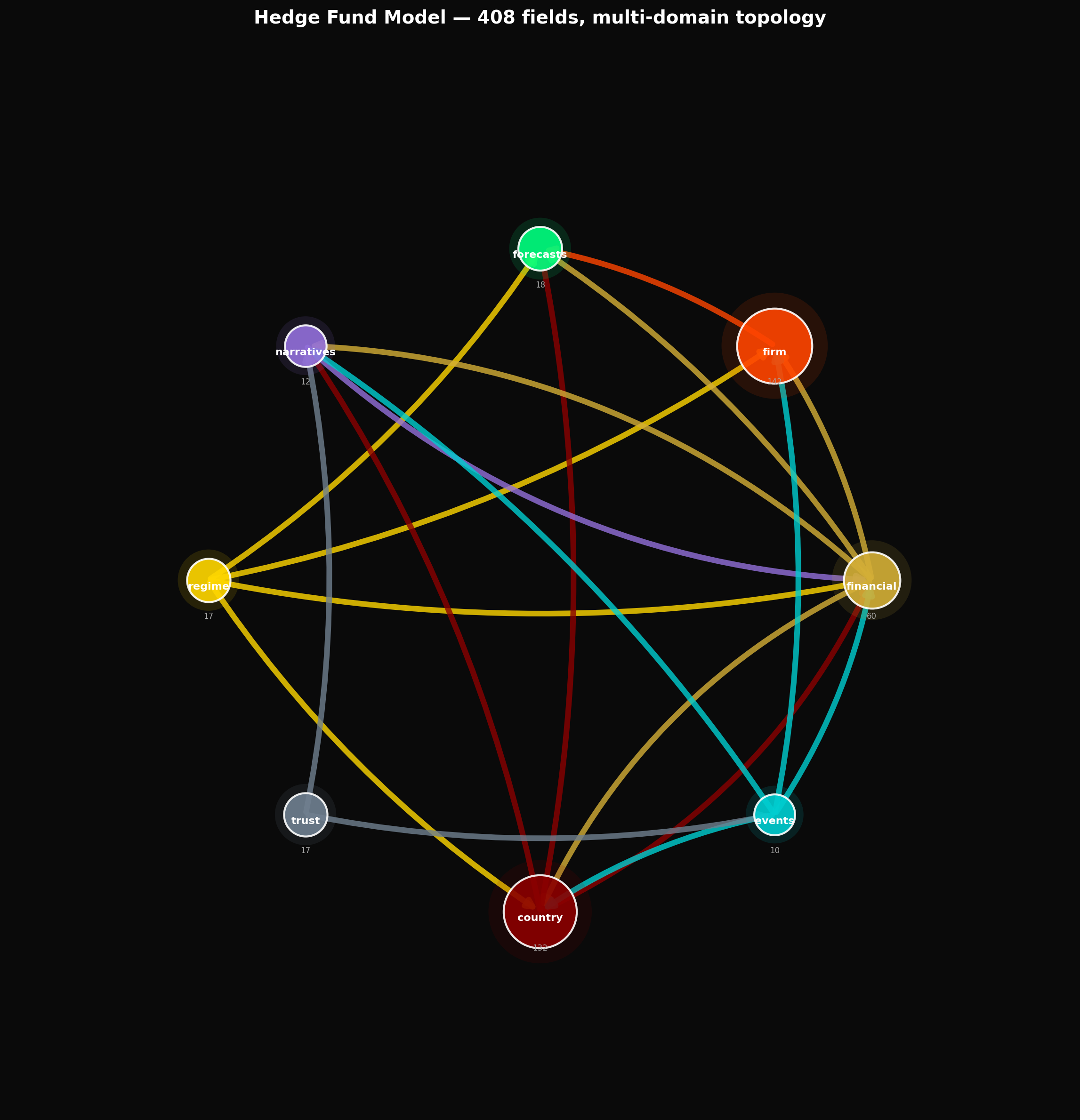
The topology defines which canvas positions attend to which. This is the compute graph of the transformer.
Canvas-engineering integration
This library depends on canvas-engineering for the compute substrate:
| Component | Role |
|---|---|
Field |
Typed unit with period, loss_weight, semantic_tag |
compile_schema |
Packs Fields onto (T, H, W) grid |
ConnectivityPolicy |
Controls intra- vs cross-domain attention |
BoundSchema |
Compiled output: layout + topology + masks |
CanvasTopology |
Declarative block-to-block attention graph |
SemanticConditioner |
Conditions canvas positions on field descriptions |
The schema defines what the world model knows. Canvas-engineering defines how it computes over that knowledge. The topology IS the compute graph.
Coarse-graining
When a subtree is excluded from a projection, its parent field is still present as a 1x1 coarse-grained Field. This means the model can still learn compressed dynamics for excluded domains: